The Beginnings of Over-The-Board Team Match Play
Posted by Webmaster on 09 Jan 2008
by Robert John McCrary
 The history of face-to-face team matches in chess logically starts with the history of chess organizations, since teams almost invariably represent organizations, or else participate in events established by organizations. The earliest known formally-organized chess organizations in the modern era were local chess clubs found in London in the 1770's. At least one of those early London clubs had formal membership, restricted to 100 members, including "statesmen, warriors, men of eminence" - as well as apparently one of Franklin's female opponents (evidently common folk need not apply, as upper and lower classes did not yet mingle in organizations). That club financed Philidor's attendance there each year, and showed evidence of regular business meetings and scheduled activities. Such chess clubs were a step up from the unorganized coffee-houses and similar meeting-places that had constituted all that was known of chess organization previously.
 Many formally-organized clubs followed the London example in the ensuing decades, and it is possible that some of these clubs played face-to-face team matches with each other when they existed in close proximity. However, no record of any such matches has been identified before about 1840, although some early matches may have gone unreported since chess magazines did not exist before the late 1830's. Another major obstacle was transportation, which was such a time-consuming and arduous process that clubs in different cities would have found a face-to-face team match simply too expensive in time and money.
All that began to change with the coming of railroads, which was making dramatic changes in people's lives by 1840, a fact readily noted in chess literature of the day. One of those changes was that chess clubs could easily visit their counterparts in other cities, and the first reported team face-to-face matches between clubs were starting to occur by 1840. They were retrospectively described in a speech by W. Robinson at the 1845 Nottingham meeting of players of the Northern and Midlands Counties' counties, as reported in Howard Staunton's The Chess Player's Chronicle, vol. V (1845) on page 281: "...several matches were made between players from the different towns in Yorkshire, who, although not the best players, were considered pretty equal in proficiency. Of course, these matches could not be played in one day; and the consequence of the visits of the players of the players of one town to the players of another was a general meeting. The first assembly of this description took place in 1840, and a great impetus being thus given to the progress of chess, he was happy to say these annual meetings had been kept up every since". This speech in 1845 was the earliest-known known reference to OTB team matches, though unfortunately details of those matches were not given. Thus, we can approximate their date only as 1840 or slightly earlier.
The annual meetings mentioned in Mr. Robinson's speech began in the Yorkshire area in England, and were the first general meetings of players from different cities. From those early Yorkshire meetings evolved the idea of national chess organizations, as the Yorkshire meetings gradually expanded to give birth to the British Chess Association in the late 1850's. George Walker, a chess author of the time, referred to those early Yorkshire meetings as "tournaments" because they reminded him of medieval tournaments involving knights and jousts. In fact the early Yorkshire annual meetings were not true tournaments or even team matches, as the competition was unstructured, limited to one day, and concluded by formal dinners with rousing speeches. Nevertheless, Walker's choice of words apparently led to use of "tournament" in modern sports and games (I traced the evolution of the word "tournament" in my paper The Birth of the Chess Tournament , issued in 1982, and credited in the 1992 Oxford Companion to Chess under the "Tournament, the" entry).
It is important to note that those Yorkshire meetings, which gave rise in time to national chess organizations and modern tournaments, were inspired by those first-known team matches between Yorkshire clubs in or before 1840. However, after that date there is no identified reference to OTB team matches until 1853, when a speech was quoted as follows in The Chess Player's Chronicle: "The representatives of two clubs might meet at some place convenient to both parties, and play a match of nine, 18, or 27 games, according to the number of delegates. But few days, indeed, could be spared for the necessary absence; yet everyone has some leisure occasionally, and far less time would be lost thus than in games by correspondence. A challenge of the nature we suggest once emanated from the Liverpool Club, but was never accepted." The speaker then apparently alluded to those early team matches, ca 1840, noted above, as well as perhaps others, as follows: "The plan we suggest has been, we believe, very successfully tried in some of the Yorkshire clubs; and, indeed, it was but the same principle under another form which prompted the establishment of the Great Yorkshire Chess Association, which is every day receiving an accession of members from the Northern and Midland counties."
Finally, a full description of a full team match was given on pp. 175-76 of the 1855 Chess Player's Chronicle, which described a "chess match between the Manchester and Liverpool chess clubs" with nine players on each side. Manchester won 12-6, although the table is unclear; most participants apparently played two games, but two pairings seem to have involved three games. Two drawn games did not count, and it is possible that the 3-game pairings were intended to replace those two draws, though they were played by other players on the team. The Manchester Examiner and Times of 21 April 1855 was quoted in the Chronicle article as follows: "Wednesday was certainly an unusual day in the annals of chess. Matches have frequently taken place between clubs by means of post; but the present is almost the only instance of an exchange of visits between two clubs."
Not long thereafter, at the June 26, 1855 meeting of the Northern and Midlands Counties' Chess Association, "matches between various clubs for prizes were played", according to p. xxiii of Lowenthal's The Chess Congress of 1862, which contained a retrospective of those early meetings that led to the first British Chess Association. Unfortunately, no details were given, and it is unclear how formal such matches may have been. Finally, it should be noted that p. 161 of The Chess Player's Chronicle of 1848 had noted that two players from the Trinity College, Cambridge Club had, in a "hasty visit" to Oxford, played against two of the best players of the Oxford Hermes Club, wining one and drawing one. No exact date or details were given from that brief encounter, in which it seemed to have been understood that the honor of those two clubs was somewhat at stake.
In conclusion, the modern era of team matches seems to begun as a product of the railroad's great impact on society in the first decades of the 19th century, in association with the birth of modern chess clubs. Furthermore, the very eariest clearly-documented matches between clubs, ca 1840, seem to have had a tremendous impact on chess history: for those matches, played between Yorkshire clubs, gave rise to the Yorkshire regional meetings; and those meetings, in turn, led to modern national organizations and tournaments.
- - -
Robert John McCrary (b.1948) is an American. He is renowned chess historian and retired US Chess Federation frontbencher. In 1980s served as President of USCF. He also played a major role in establishing the World Chess hall of Fame (Miami, FL). His chess history research focuses on years between 1600 and 1900. He used to run a chess history column in "Chess Life" presenting a brief overview of chess history from the beginning to the present. His research was used a.o. by "Smithsonian" and the Canadian "Readers' Digest". R.J.McCrary has a Ph.D in psychology and worked as professional physician. He is married with two adult daughters.
The findings given above were provided by the author to the "Chess Notes" column of Edward Winter, where they were recently published with appropriate credit.
Worth a glance: Association of Chess Professionals
Posted by Webmaster on 28 Dec 2007
 ACP (Association of Chess Professionals) is an international not-for-profit organisation, which was founded in Paris in September 2003. A large group of strong professional players gathered together to set up a new body for international chess.
 The ACP is run by a Board of nine elected members. Its President is the Grandmaster Pavel Tregubov, European Champion 2000.
The ACP presently regroups 240 top chess professionals from all over the world (including 17 players out of world top 20), including the reigning World Champion Viswanathan Anand (India).
The ACP’s foremost objective is the worldwide promotion of the game of chess. Here is a list of its most important achievements:
In April and May 2004, three Internet chess tournaments were staged, with the participation of over 100 Grandmasters and a record attendance of more than 200,000 unique spectators online.
In July 2004, the ACP Tour was launched. This brand new series unites all major international tournaments into one circuit for a one-year chess season. The ACP Tour now includes more than 60 tournaments all over the world. In September/October 2004, the final of the World Chess Championship was staged under the ACP aegis in Brissago (Switzerland), between titleholder Vladimir Kramnik from Russia and his challenger Peter Leko from Hungary.
In September 2005, the first blitz tournament in the chess history with the participation of the chess stars was broadcasted live on the Russian TV channel NTV+. In January 2007, the first ACP World Rapid Cup was organised in Odessa (Ukraine).
"Worth a glance" is our brand new project aimed at promoting interesting chess sites. Webmasters of professional chess sites are welcome to contact us in order to exchange introductory messages.
Merry Chrismas! Teresa turnes two
Posted by Webmaster on 24 Dec 2007
 We wish you the Merry Christmas and a happy New Year 2008! May the chess lovers' community grow and get stronger and stronger year by year. In March it will have been four years as our site is online.
  It grew incredibly with the disinterested help of hundreds of chess fans from all over the world who devoted their leisure time and often money to help the unique data from old, dust-covered magazines and bulletins see the sunlight and be freely available for everyone, forever. Thank you all for all! It is great honour to work together.
As the news is published at 11:02 PM it is the very moment when my daughter Teresa was born two years ago. She is now charming and pretty young lady. But that is not all! My wife is going to deliver our second sweetie Klara in February. The bad news is that I still haven't got a son who could one day possibly succeed my chess deed. Time will tell.
There is a Christmas problem for you to solve. Drag your mouse below the brackets to reveal the answer. How fast did you success?
Black to move and mate in 2.
[ 1... bxc3 e.p. (en passant!) 2. a3 (or whatever else) c2# - very easy, isn't it? ]
New Rules for the Chess Olympiads
Posted by Webmaster on 11 Dec 2007
 FIDE Executive Board approved, in its recent meeting in Antalya, Turkey, new rules for the Chess Olympiads, which will come into effect at the 2008 Dresden Olympiad. As there are many significant changes, FIDE draws the attention of national federations to ensure that they and their players are acquainted with the new rules before they attend the Olympiad.
 After 50 years (until 1974) of playing the Chess Olympiads under the round-robin system (mostly with preliminaries and finals), FIDE adopted (from 1976) the Swiss System. Mr. Almog Burstein, Chairman of the Technical Administration Panel, introduces the main important changes:
1. The number of boards in each match in the Women's Olympiad was increased from 3 to 4; the number of reserve players in the Open Olympiad was reduced from 2 to 1. That means that all teams in both olympiads will be composed of four players and one reserve.
My comment: acceptable. Increase of number of women's boards up to 4 results in both teams playing equal number of games with white and black pieces. Decreasing size of men's team was inevitable in the era of cost-cuting.
2. The number of rounds was reduced to 11 (instead of 13-14 rounds in previous Olympiads).
My comment: wrong. Swiss is a lottery itself. The less rounds, the more mess. Still, I understand time is money, and less rounds means less time spent on play.
3. In the first round, two `imaginary` match points shall be added, for pairing purposes only, to each of the teams in the top half of the initial list. That means that in an Olympiad with 120 teams, the pairings for the first round will be 1-31, 2-32, 3-33 ... 29-59, 30-60 and then 61-91, 62-92, 63-93 etc. (instead of 1-61, 2-62, 3-63 etc. in previous Olympiads).
4. In the second round, the winning teams in the top half will play with one another (i.e. 1-16, 2-17 etc.), the losing teams in the bottom half will play with one another (i.e. 91-106, 92-107), while the losing teams in the top half will play against the winning teams in the bottom half! (i.e. 31-61, 32-62, 33-63 etc.). This way we `save` one round which is very important towards the end of the Olympiad. The `imaginary` points shall be deducted before making the pairings for the third round.
My comment on 3&4: nonsence! This has apparently been invented to compensate decrease in the number of rounds. However, the similar system was adopted in 1990 and quickly abolished. Also, please take into consideration that the only real idea behind the Swiss is that the minnows might be paired with the giants. The newly adopted system makes it virtually impossible forever.
5. The final standing shall be determined by match points (instead of game points). That means that the winning team in each match (by game result of 2.5:1.5, 3:1, 3.5:0.5 or 4:0) gets 2 match points while its opponent gets no match points. In case of a draw (game result of 2:2) each team gets one match point.
My comment: acceptable. There are pros and cons of this solution compared to standard game point order rule, still both possibilities are acceptable. On one hand game points seem to be more "precise", while on the other adopting match point rule incorporates a real team spirit into the game.
6. The position of teams that finish with the same number of match points shall be determined by the Sonnenborn-Berger system which is the sum of the match points of all opponents, excluding the opponent who scored the lowest number of match points, while each opponent's match score is multiplied by the team's game result against this opponent. The idea behind this new rule is to combine, in the first procedure of the tie breaking, both the strength of the opponents and the number of game points scored against each one of them. The more game points scored against stronger opponents, the better for the team. This way we also give the teams a substantial incentive to win as many game points as possible in each match and not to be satisfied with the minimal win of 2.5:1.5. The exclusion of the weakest opponent is made in order to neutralize the effect of non played matches on the final results.
My comment: good. It is widely known that as long as the final order is decided by match points, the game points are the worst possible tie-breaker (see Euro TCh as a negative example). The proposed system is most fair in this case.
7. If Sonnenborn-Berger does not break the tie, the next tie-breaking procedures are: (b = Buchholz) by the sum of the match scores of all the team's opponents, excluding the opponent who scored the lowest number of match points; and (c) by the sum of the game points scored.
8. The standing after each round, according to the procedure explained in points 5-7 above, is also the basis for the pairings of each next round.
Summary: nothing radical as it seems at first glance. It is still the same, unfair Swiss system with all its disadvantages. The number of games is to diminish considerably making the whole event shorter and cheaper. Was that the main idea behind the change?
What do you think? Post your comment!
/ taken from www.fide.com /
USSR beat Yugoslavia and yes, that's in a year 2007!
Posted by Webmaster on 19 Nov 2007
 Now hang on, we hear you say, the two nation states have long ceased to exist? But this week organisers in Moscow rolled back the clock and staged a match in the tradition of the famous friends-and-rivals encounters of the 1950s-80s. The teams consisted of veteran players who had taken part in the matches during the heyday of the Soviet era.
 Collectors of Soviet chess literature will probably be familiar with the book "Druzya i soperniki" ("Friends and rivals"), which deals with the history of the USSR-Yugoslavia chess matches. Throughout the 1950s to 1980s, these annual matches were one of the most impressive events of the international chess calendar, and produced some great chess.
Over the past 15 or so years, both the Soviet Union and Yugoslavia have ceased to exist as nation states, but this week in Moscow, an attempt was made to roll back the clock. The Russian capital played host to a two-round USSR-Yugoslavia match, involving teams of veteran players, all of whom had taken part in the matches during the heyday of the Soviet era.
The "USSR" team was led by Victor Korchnoi, now a Swiss citizen, but restored to "honorary" Soviet citizenship for the two days of this match. Opposing him on board one was Svetozar Gligorić, who had lead the Yugoslav team with success on so many former occasions. The ten-board teams included Taimanov, Averbakh, Vasyukov and Balashov on the USSR side, and Ivkov, Matanovic, Velimirovic and Karaklaic for Yugoslavia.
/ taken from chessbase.com /
See tournament home page
| Moscow (Russia), 8th - 10th November 2007 | |||||||
| URS | Soviet Union | 11 : 9 | Yugoslavia | YUG | |||
| 6 : 4 | 5 : 5 | ||||||
GM Kortschnoj b. 1931 b. 1931 | 2611 | 1 - 0 | 2447 | GM Gligorić b. 1923 b. 1923 | |||
| ½ - ½ | |||||||
GM Vasiukov b. 1933 b. 1933 | 2492 | ½ - ½ | 2405 | GM Ivkov b. 1933 | |||
| ½ - ½ | |||||||
| GM Taimanov b. 1926 | 2393 | ½ - ½ | 2490 | GM Matanovic b. 1930 | |||
| ½ - ½ | |||||||
| GM Balashov b. 1949 | 2440 | 0 - 1 | 2442 | GM Velimirovic b. 1942 | |||
| ½ - ½ | |||||||
| GM Zaitsev b. 1938 | 2437 | ½ - ½ | 2317 | IM Karaklajic b. 1926 | |||
| ½ - ½ | |||||||
| GM Averbakh b. 1922 | 2445 | ½ - ½ | 2186 | FM S.Vlahovic b. 1948 | |||
| 0 - 1 | |||||||
| GM Vorotnikov b. 1947 | 2425 | ½ - ½ | 2250 | Spasojevic b. 1943 | |||
| 1 - 0 | |||||||
| GM Makhulsky b. 1956 | 2505 | ½ - ½ | 2091 | A.Savic b. 1947 | |||
| ½ - ½ | |||||||
| WGM Fatabelikova b. 1947 | 2276 | 1 - 0 | 2175 | WGM Lazarevic b. 1932 | |||
| ½ - ½ | |||||||
| WGM Zaitseva b. 1956 | 2352 | 1 - 0 | 2180 | WGM Blagojevic b. 1943 | |||
| ½ - ½ | |||||||
Here is concise history of the 22 USSR-Yugoslavia matches:
1. 1956 Belgrade: Yugoslavia-Soviet Union 26-38
2. 1957 Leningrad: Soviet Union-Yugoslavia 42-22
3. 1958 Zagreb: Yugoslavia-Soviet Union 12½-19½ (3½-4½, 3-5, 3-5, 3-5)
4. 1959 Kyiv: Soviet Union-Yugoslavia 24½-15½ (5½-4½, 5-5, 7-3, 7-3)
5. 1961 Belgrade: Yugoslavia-Soviet Union 28½-31½
6. 1962 Lviv: Soviet Union-Yugoslavia 37-23
7. 1963 Rijeka: Yugoslavia-Soviet Union 24½-35½ (3½-6½, 4½-5½, 3-7, 3½-6½, 4½-5½, 5½-4½)
8. 1964 Leningrad: Soviet Union-Yugoslavia 38½-21½ (7½-2½, 7-3, 5-5, 6½-3½, 7-3, 5½-4½)
9. 1965 Vrnjacka Banja: Yugoslavia-Soviet Union 22-38 (2-8, 4-6, 4½-5½, 3½-6½, 3½-6½, 4½-5½)
10. 1966 Sukhumi: Soviet Union-Yugoslavia 37½-22½ (8-2, 6-4, 6½-3½, 6-4, 5-5, 6-4)
11. 1967 Budva: Yugoslavia-Soviet Union 28½-43½
12. 1968 Sochi: Soviet Union-Yugoslavia 30½-17½ (9½-2½, 8½-3½, 6½-5½, 6-6)
13. 1969 Skopje: Yugoslavia-Soviet Union 18-22 (5-5, 3½-6½, 4½-5½, 5-5)
14. 1971 Yerevan: Soviet Union-Yugoslavia 35-19 (6½-2½, 7-2, 5½-3½, 4½-4½, 6½-2½, 5-4)
15. 1972 Ohrid: Yugoslavia-Soviet Union 13½-26½ (men 10½-13½ , women 2-6, juniors 1-7)
16. 1973 Tbilisi: Soviet Union-Yugoslavia 31-15 (7-5, 9½-2½, 8½-2½, 6-5), men 14-10, women 8½-1½, juniors 8½-3½
17. 1974 Belgrade: Yugoslavia-Soviet Union 16½-19½
18. 1975 Odessa: Soviet Union-Yugoslavia 20-16
19. 1976 Krk (U30): Yugoslavia-Soviet Union 11-29 (3½-6½, 2½-7½, 3-7, 2-8)
20. 1977 Tallinn (U30): Soviet Union-Yugoslavia 31-9 (7-3, 8½-1½, 9-1, 6½-3½)
21. 1979 Teslic: Yugoslavia-Soviet Union 15-25 (5-5, 3½-6½, 3-7, 3½-6½)
22. 2007 Moscow: Soviet Union-Yugoslavia 11-9 (5-5, 6-4)
Total: 22 Soviet wins, no draws, no Yugoslavia wins (!). Points 666-388
Euro 2007: Russian doublet
Posted by Webmaster on 14 Nov 2007
 European Team Championships was held in Crete, Greece from 27 October to 7 November 2007. There were 40 men's and 30 women's, each one comprised of four players and a reserve. The system of play was nine round Swiss and the final order was decided by match points while game points were controversially used for purposes of tie-splitting (it is commonly believed Buchholz is more fair as tie-break).
The event drew most top European players, including Topalov, Svidler, Morozevich, Adams, Mamedyarov, Ivanchuk and Shirov. As much as 66 men were rated +2600.
In the men's teams tournament, Russia conquered the title after showing excellent performance scoring 8 wins and one draw. Svidler scored magic 6/7 at top board while player #2 was Morozevich with 6/8. The victory against Israel in the last round's decider was crucial for Armenia who finished second (best player Sargissian 6.5/9). The young Azeri team took bronze after beating France in the last round edging out Poland who recovered greatly after miserable start. Incumbent champions Holland finished in poor 19th.
In the women's teams event, Russia scored 6 wins and 3 draws to take their first title ever (no nation managed to win the title more than once!). Poland, the titleholders, came second while bronze was taken by surprise Armenia. Best individual result was scored by Nemcova of the Czech republic - 7.5/9.
FINAL RESULTS MEN (see details here):
1. Russia 17
2. Armenia 14
3. Azerbaijan 13
4. Poland, Ukraine, Israel 12
...(40)
FINAL RESULTS WOMEN (see details here):
1. Russia 15
2. Poland 13
3. Armenia 13
4. Ukraine, Georgia, Slovenia 12
...(30)
See OlimpBase info&result page: men, women
See European Team Championship all-time statistics: men, women
See tournament home page
See daily report at chessdom.com
Spain and Monaco take Euro top trophies
Posted by Webmaster on 28 Oct 2007
 The sunny Turkish resort Kemer hosted 23rd European Club Cup to meet 56 men's and 18 women's teams in this annual competition. The event drew most World's top players.
 With a convincing last day 4-2 win over Economist SGSEU-1 Saratov, Linex-Magic had won the European Club Cup for the first time in their short history. In the final match Kamsky, Rublevsky and Cheparinov scored important victories against Alexeev, Tiviakov and Roiz repectively. The team from Merida (Spain) won the tournament with 13 points out of 7 matches. Second finished Ural Sverdlovskaya and shared third were Tomsk-400 and OSC Baden-Baden. In the women’s section, Cercle d’Echecs de Monte-Carlo only needed to score one game point to grab the cup and that was exactly what they did: a surprising last-round loss (1-3) against AVS Krasnoturinsk was just enough.
The winning team consisted of Gata Kamsky (3/7), Michael Adams (4.5), Sergey Rublevsky (5.5), Gabriel Sargissian (4.5), Ivan Cheparinov (6) and Manuel Perez Candelario (5). On board one, Krishnan Sasikiran had the best tournament of all with a 85.7% score (6/7, a performance rating of 2806). Alexei Shirov scored the highest performance rating (2875). Shakhryiar Mamedyarov, Pavel Eljanov, Peter Svidler and Sergei Rublevsky also scored performances above 2800. Humpy Koneru, who passed the 2600 mark on the October FIDE rating list, continues her fantastic year with an amazing 5.5 out of 6 and a 2800 performance in the women’s section.
FINAL RESULTS (MEN):

 1 Linex Magic - Merida      7   6   1   0   13   28,5   174,0
 2 Ural Sverdlovskaya        7   5   2   0   12   31,0   157,5
 3 Tomsk-400                 7   5   1   1   11   29,0   174,0
 4 Baden-Baden               7   4   3   0   11   28,5   161,0
 5 Chess Club Zagreb         7   5   0   2   10   31,5   134,0
 6 Economist Saratov         7   5   0   2   10   28,0   156,0
 7 Zeljeznicar Sarajevo      7   5   0   2   10   28,0   153,5
 8 Keystone Kyiv             7   5   0   2   10   27,5   158,5
 9 Bosna Sarajevo            7   4   2   1   10   26,0   183,0
10 Aquaprofit Nagykanisza    7   5   0   2   10   26,0   160,0
(total of 56 teams)

FINAL RESULTS (WOMEN):

 1 CE Monte-Carlo            7   5   1   1   11   20,0   104,0
 2 AVS Krasnoturinsk         7   5   1   1   11   19,0   109,5
 3 MIKA Yerevan              7   5   0   2   10   19,0    99,5
 4 Southern Ural Cheliabinsk 7   5   0   2   10   18,0   115,0
 5 Finek St.Petersburg       7   5   0   2   10   18,0   104,5
 6 Economist Saratov         7   4   0   3    8   17,5    99,0
 7 SK Podgorica              7   3   2   2    8   16,0   105,5
 8 Interplast Tbilisi        7   3   2   2    8   15,5   120,0
 9 Utrecht                   7   3   1   3    7   14,0    88,5
10 Ladya Kazan               7   3   1   3    7   13,0   107,0
(total of 18 teams)
See tournament's home page
See ChessBase.com report
See ChessVibes.com report
See results at chess-results.com: men and women
Mario Serracino-Inglott dies at 73
Posted by Webmaster on 11 Oct 2007
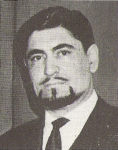 Sad news arrived from Malta. Mario Serracino-Inglott, a prominent figure in Maltese chess and devoted friend of OlimpBase (it is him who provided with the unavailable results of the 1980 Chess Olympiad) died at 73 on Saturday, 22nd September 2007.
He was born in Cospicua in 1934. In 1953 he became a clerk at the Dockyard and two years later he joined the civil service as a clerical officer, retiring in 1985 to teach Maltese at Stella Maris College. He also used to be a vice-president of Akkademja tal-Malti.
He had three Big Loves in his life: apart from his family, wife Joan Antida and daughter Lara, they were both inherited from his father: the Maltese language and chess. Since 1983, he had been editing unpublished Maltese manuscripts of his father Erin Serracino-Inglott including one named Il-Miklem Malti. He also compiled his own dictionary and thesaurus, Dizzjunarju Malti. For a number of years he was a teacher of Maltese. For him Maltese was "a great and beautiful language that is second to no other language and that first and foremost makes us what we are - Maltese."
His chess achievements were no worse making him one of most important figures in the history of Maltese chess. In 1947 he was first and youngest ever Malta junior champion. He also wrote a book on a history of chess in Malta 1800-1990. Although he never committed himself to a professional chess career he took part in two international chess tournaments: in La Spezia (Italy) and Yugoslavia in 1957. For many years he served as president of the Malta Chess Association. In 1980 he was the first Maltese to be officially awarded the title of the International Chess Arbiter (IA). On that year he was co-organizer of the 24th Chess Olympiad in La Valletta.
Relatives remembered him as an avid chess player, a classical music and opera fan, a man with an eye for detail, a lover of culture in general, and in particular of all that contributes to the national identity, his memory lives on forever in his works.
My own relationship with Mario was fruitful and truly inspiring. Despite of his age and declining health he was very optimistic and benevolent personality, open for new challenges and helpful to the others. He greatly contributed to growth of our archives, sending original bulletins from Malta 1980 Olympiad; he was also so nice to write an essay with his reminiscences from past years exclusively for OlimpBase readers. It means even more for us these sad days.
He will be deeply missed by the international chess community.
May you rest in peace, Mario.
Wojtek Bartelski
OlimpBase Head Webmaster
Powered by CuteNews