New Rules for the Chess Olympiads
Posted by Webmaster on 11 Dec 2007
 FIDE Executive Board approved, in its recent meeting in Antalya, Turkey, new rules for the Chess Olympiads, which will come into effect at the 2008 Dresden Olympiad. As there are many significant changes, FIDE draws the attention of national federations to ensure that they and their players are acquainted with the new rules before they attend the Olympiad.
 After 50 years (until 1974) of playing the Chess Olympiads under the round-robin system (mostly with preliminaries and finals), FIDE adopted (from 1976) the Swiss System. Mr. Almog Burstein, Chairman of the Technical Administration Panel, introduces the main important changes:
1. The number of boards in each match in the Women's Olympiad was increased from 3 to 4; the number of reserve players in the Open Olympiad was reduced from 2 to 1. That means that all teams in both olympiads will be composed of four players and one reserve.
My comment: acceptable. Increase of number of women's boards up to 4 results in both teams playing equal number of games with white and black pieces. Decreasing size of men's team was inevitable in the era of cost-cuting.
2. The number of rounds was reduced to 11 (instead of 13-14 rounds in previous Olympiads).
My comment: wrong. Swiss is a lottery itself. The less rounds, the more mess. Still, I understand time is money, and less rounds means less time spent on play.
3. In the first round, two `imaginary` match points shall be added, for pairing purposes only, to each of the teams in the top half of the initial list. That means that in an Olympiad with 120 teams, the pairings for the first round will be 1-31, 2-32, 3-33 ... 29-59, 30-60 and then 61-91, 62-92, 63-93 etc. (instead of 1-61, 2-62, 3-63 etc. in previous Olympiads).
4. In the second round, the winning teams in the top half will play with one another (i.e. 1-16, 2-17 etc.), the losing teams in the bottom half will play with one another (i.e. 91-106, 92-107), while the losing teams in the top half will play against the winning teams in the bottom half! (i.e. 31-61, 32-62, 33-63 etc.). This way we `save` one round which is very important towards the end of the Olympiad. The `imaginary` points shall be deducted before making the pairings for the third round.
My comment on 3&4: nonsence! This has apparently been invented to compensate decrease in the number of rounds. However, the similar system was adopted in 1990 and quickly abolished. Also, please take into consideration that the only real idea behind the Swiss is that the minnows might be paired with the giants. The newly adopted system makes it virtually impossible forever.
5. The final standing shall be determined by match points (instead of game points). That means that the winning team in each match (by game result of 2.5:1.5, 3:1, 3.5:0.5 or 4:0) gets 2 match points while its opponent gets no match points. In case of a draw (game result of 2:2) each team gets one match point.
My comment: acceptable. There are pros and cons of this solution compared to standard game point order rule, still both possibilities are acceptable. On one hand game points seem to be more "precise", while on the other adopting match point rule incorporates a real team spirit into the game.
6. The position of teams that finish with the same number of match points shall be determined by the Sonnenborn-Berger system which is the sum of the match points of all opponents, excluding the opponent who scored the lowest number of match points, while each opponent's match score is multiplied by the team's game result against this opponent. The idea behind this new rule is to combine, in the first procedure of the tie breaking, both the strength of the opponents and the number of game points scored against each one of them. The more game points scored against stronger opponents, the better for the team. This way we also give the teams a substantial incentive to win as many game points as possible in each match and not to be satisfied with the minimal win of 2.5:1.5. The exclusion of the weakest opponent is made in order to neutralize the effect of non played matches on the final results.
My comment: good. It is widely known that as long as the final order is decided by match points, the game points are the worst possible tie-breaker (see Euro TCh as a negative example). The proposed system is most fair in this case.
7. If Sonnenborn-Berger does not break the tie, the next tie-breaking procedures are: (b = Buchholz) by the sum of the match scores of all the team's opponents, excluding the opponent who scored the lowest number of match points; and (c) by the sum of the game points scored.
8. The standing after each round, according to the procedure explained in points 5-7 above, is also the basis for the pairings of each next round.
Summary: nothing radical as it seems at first glance. It is still the same, unfair Swiss system with all its disadvantages. The number of games is to diminish considerably making the whole event shorter and cheaper. Was that the main idea behind the change?
What do you think? Post your comment!
/ taken from www.fide.com /
USSR beat Yugoslavia and yes, that's in a year 2007!
Posted by Webmaster on 19 Nov 2007
 Now hang on, we hear you say, the two nation states have long ceased to exist? But this week organisers in Moscow rolled back the clock and staged a match in the tradition of the famous friends-and-rivals encounters of the 1950s-80s. The teams consisted of veteran players who had taken part in the matches during the heyday of the Soviet era.
 Collectors of Soviet chess literature will probably be familiar with the book "Druzya i soperniki" ("Friends and rivals"), which deals with the history of the USSR-Yugoslavia chess matches. Throughout the 1950s to 1980s, these annual matches were one of the most impressive events of the international chess calendar, and produced some great chess.
Over the past 15 or so years, both the Soviet Union and Yugoslavia have ceased to exist as nation states, but this week in Moscow, an attempt was made to roll back the clock. The Russian capital played host to a two-round USSR-Yugoslavia match, involving teams of veteran players, all of whom had taken part in the matches during the heyday of the Soviet era.
The "USSR" team was led by Victor Korchnoi, now a Swiss citizen, but restored to "honorary" Soviet citizenship for the two days of this match. Opposing him on board one was Svetozar Gligorić, who had lead the Yugoslav team with success on so many former occasions. The ten-board teams included Taimanov, Averbakh, Vasyukov and Balashov on the USSR side, and Ivkov, Matanovic, Velimirovic and Karaklaic for Yugoslavia.
/ taken from chessbase.com /
See tournament home page
| Moscow (Russia), 8th - 10th November 2007 | |||||||
| URS | Soviet Union | 11 : 9 | Yugoslavia | YUG | |||
| 6 : 4 | 5 : 5 | ||||||
GM Kortschnoj b. 1931 b. 1931 | 2611 | 1 - 0 | 2447 | GM Gligorić b. 1923 b. 1923 | |||
| ½ - ½ | |||||||
GM Vasiukov b. 1933 b. 1933 | 2492 | ½ - ½ | 2405 | GM Ivkov b. 1933 | |||
| ½ - ½ | |||||||
| GM Taimanov b. 1926 | 2393 | ½ - ½ | 2490 | GM Matanovic b. 1930 | |||
| ½ - ½ | |||||||
| GM Balashov b. 1949 | 2440 | 0 - 1 | 2442 | GM Velimirovic b. 1942 | |||
| ½ - ½ | |||||||
| GM Zaitsev b. 1938 | 2437 | ½ - ½ | 2317 | IM Karaklajic b. 1926 | |||
| ½ - ½ | |||||||
| GM Averbakh b. 1922 | 2445 | ½ - ½ | 2186 | FM S.Vlahovic b. 1948 | |||
| 0 - 1 | |||||||
| GM Vorotnikov b. 1947 | 2425 | ½ - ½ | 2250 | Spasojevic b. 1943 | |||
| 1 - 0 | |||||||
| GM Makhulsky b. 1956 | 2505 | ½ - ½ | 2091 | A.Savic b. 1947 | |||
| ½ - ½ | |||||||
| WGM Fatabelikova b. 1947 | 2276 | 1 - 0 | 2175 | WGM Lazarevic b. 1932 | |||
| ½ - ½ | |||||||
| WGM Zaitseva b. 1956 | 2352 | 1 - 0 | 2180 | WGM Blagojevic b. 1943 | |||
| ½ - ½ | |||||||
Here is concise history of the 22 USSR-Yugoslavia matches:
1. 1956 Belgrade: Yugoslavia-Soviet Union 26-38
2. 1957 Leningrad: Soviet Union-Yugoslavia 42-22
3. 1958 Zagreb: Yugoslavia-Soviet Union 12½-19½ (3½-4½, 3-5, 3-5, 3-5)
4. 1959 Kyiv: Soviet Union-Yugoslavia 24½-15½ (5½-4½, 5-5, 7-3, 7-3)
5. 1961 Belgrade: Yugoslavia-Soviet Union 28½-31½
6. 1962 Lviv: Soviet Union-Yugoslavia 37-23
7. 1963 Rijeka: Yugoslavia-Soviet Union 24½-35½ (3½-6½, 4½-5½, 3-7, 3½-6½, 4½-5½, 5½-4½)
8. 1964 Leningrad: Soviet Union-Yugoslavia 38½-21½ (7½-2½, 7-3, 5-5, 6½-3½, 7-3, 5½-4½)
9. 1965 Vrnjacka Banja: Yugoslavia-Soviet Union 22-38 (2-8, 4-6, 4½-5½, 3½-6½, 3½-6½, 4½-5½)
10. 1966 Sukhumi: Soviet Union-Yugoslavia 37½-22½ (8-2, 6-4, 6½-3½, 6-4, 5-5, 6-4)
11. 1967 Budva: Yugoslavia-Soviet Union 28½-43½
12. 1968 Sochi: Soviet Union-Yugoslavia 30½-17½ (9½-2½, 8½-3½, 6½-5½, 6-6)
13. 1969 Skopje: Yugoslavia-Soviet Union 18-22 (5-5, 3½-6½, 4½-5½, 5-5)
14. 1971 Yerevan: Soviet Union-Yugoslavia 35-19 (6½-2½, 7-2, 5½-3½, 4½-4½, 6½-2½, 5-4)
15. 1972 Ohrid: Yugoslavia-Soviet Union 13½-26½ (men 10½-13½ , women 2-6, juniors 1-7)
16. 1973 Tbilisi: Soviet Union-Yugoslavia 31-15 (7-5, 9½-2½, 8½-2½, 6-5), men 14-10, women 8½-1½, juniors 8½-3½
17. 1974 Belgrade: Yugoslavia-Soviet Union 16½-19½
18. 1975 Odessa: Soviet Union-Yugoslavia 20-16
19. 1976 Krk (U30): Yugoslavia-Soviet Union 11-29 (3½-6½, 2½-7½, 3-7, 2-8)
20. 1977 Tallinn (U30): Soviet Union-Yugoslavia 31-9 (7-3, 8½-1½, 9-1, 6½-3½)
21. 1979 Teslic: Yugoslavia-Soviet Union 15-25 (5-5, 3½-6½, 3-7, 3½-6½)
22. 2007 Moscow: Soviet Union-Yugoslavia 11-9 (5-5, 6-4)
Total: 22 Soviet wins, no draws, no Yugoslavia wins (!). Points 666-388
Euro 2007: Russian doublet
Posted by Webmaster on 14 Nov 2007
 European Team Championships was held in Crete, Greece from 27 October to 7 November 2007. There were 40 men's and 30 women's, each one comprised of four players and a reserve. The system of play was nine round Swiss and the final order was decided by match points while game points were controversially used for purposes of tie-splitting (it is commonly believed Buchholz is more fair as tie-break).
The event drew most top European players, including Topalov, Svidler, Morozevich, Adams, Mamedyarov, Ivanchuk and Shirov. As much as 66 men were rated +2600.
In the men's teams tournament, Russia conquered the title after showing excellent performance scoring 8 wins and one draw. Svidler scored magic 6/7 at top board while player #2 was Morozevich with 6/8. The victory against Israel in the last round's decider was crucial for Armenia who finished second (best player Sargissian 6.5/9). The young Azeri team took bronze after beating France in the last round edging out Poland who recovered greatly after miserable start. Incumbent champions Holland finished in poor 19th.
In the women's teams event, Russia scored 6 wins and 3 draws to take their first title ever (no nation managed to win the title more than once!). Poland, the titleholders, came second while bronze was taken by surprise Armenia. Best individual result was scored by Nemcova of the Czech republic - 7.5/9.
FINAL RESULTS MEN (see details here):
1. Russia 17
2. Armenia 14
3. Azerbaijan 13
4. Poland, Ukraine, Israel 12
...(40)
FINAL RESULTS WOMEN (see details here):
1. Russia 15
2. Poland 13
3. Armenia 13
4. Ukraine, Georgia, Slovenia 12
...(30)
See OlimpBase info&result page: men, women
See European Team Championship all-time statistics: men, women
See tournament home page
See daily report at chessdom.com
Spain and Monaco take Euro top trophies
Posted by Webmaster on 28 Oct 2007
 The sunny Turkish resort Kemer hosted 23rd European Club Cup to meet 56 men's and 18 women's teams in this annual competition. The event drew most World's top players.
 With a convincing last day 4-2 win over Economist SGSEU-1 Saratov, Linex-Magic had won the European Club Cup for the first time in their short history. In the final match Kamsky, Rublevsky and Cheparinov scored important victories against Alexeev, Tiviakov and Roiz repectively. The team from Merida (Spain) won the tournament with 13 points out of 7 matches. Second finished Ural Sverdlovskaya and shared third were Tomsk-400 and OSC Baden-Baden. In the women’s section, Cercle d’Echecs de Monte-Carlo only needed to score one game point to grab the cup and that was exactly what they did: a surprising last-round loss (1-3) against AVS Krasnoturinsk was just enough.
The winning team consisted of Gata Kamsky (3/7), Michael Adams (4.5), Sergey Rublevsky (5.5), Gabriel Sargissian (4.5), Ivan Cheparinov (6) and Manuel Perez Candelario (5). On board one, Krishnan Sasikiran had the best tournament of all with a 85.7% score (6/7, a performance rating of 2806). Alexei Shirov scored the highest performance rating (2875). Shakhryiar Mamedyarov, Pavel Eljanov, Peter Svidler and Sergei Rublevsky also scored performances above 2800. Humpy Koneru, who passed the 2600 mark on the October FIDE rating list, continues her fantastic year with an amazing 5.5 out of 6 and a 2800 performance in the women’s section.
FINAL RESULTS (MEN):

 1 Linex Magic - Merida      7   6   1   0   13   28,5   174,0
 2 Ural Sverdlovskaya        7   5   2   0   12   31,0   157,5
 3 Tomsk-400                 7   5   1   1   11   29,0   174,0
 4 Baden-Baden               7   4   3   0   11   28,5   161,0
 5 Chess Club Zagreb         7   5   0   2   10   31,5   134,0
 6 Economist Saratov         7   5   0   2   10   28,0   156,0
 7 Zeljeznicar Sarajevo      7   5   0   2   10   28,0   153,5
 8 Keystone Kyiv             7   5   0   2   10   27,5   158,5
 9 Bosna Sarajevo            7   4   2   1   10   26,0   183,0
10 Aquaprofit Nagykanisza    7   5   0   2   10   26,0   160,0
(total of 56 teams)

FINAL RESULTS (WOMEN):

 1 CE Monte-Carlo            7   5   1   1   11   20,0   104,0
 2 AVS Krasnoturinsk         7   5   1   1   11   19,0   109,5
 3 MIKA Yerevan              7   5   0   2   10   19,0    99,5
 4 Southern Ural Cheliabinsk 7   5   0   2   10   18,0   115,0
 5 Finek St.Petersburg       7   5   0   2   10   18,0   104,5
 6 Economist Saratov         7   4   0   3    8   17,5    99,0
 7 SK Podgorica              7   3   2   2    8   16,0   105,5
 8 Interplast Tbilisi        7   3   2   2    8   15,5   120,0
 9 Utrecht                   7   3   1   3    7   14,0    88,5
10 Ladya Kazan               7   3   1   3    7   13,0   107,0
(total of 18 teams)
See tournament's home page
See ChessBase.com report
See ChessVibes.com report
See results at chess-results.com: men and women
Mario Serracino-Inglott dies at 73
Posted by Webmaster on 11 Oct 2007
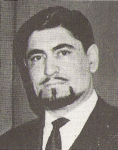 Sad news arrived from Malta. Mario Serracino-Inglott, a prominent figure in Maltese chess and devoted friend of OlimpBase (it is him who provided with the unavailable results of the 1980 Chess Olympiad) died at 73 on Saturday, 22nd September 2007.
He was born in Cospicua in 1934. In 1953 he became a clerk at the Dockyard and two years later he joined the civil service as a clerical officer, retiring in 1985 to teach Maltese at Stella Maris College. He also used to be a vice-president of Akkademja tal-Malti.
He had three Big Loves in his life: apart from his family, wife Joan Antida and daughter Lara, they were both inherited from his father: the Maltese language and chess. Since 1983, he had been editing unpublished Maltese manuscripts of his father Erin Serracino-Inglott including one named Il-Miklem Malti. He also compiled his own dictionary and thesaurus, Dizzjunarju Malti. For a number of years he was a teacher of Maltese. For him Maltese was "a great and beautiful language that is second to no other language and that first and foremost makes us what we are - Maltese."
His chess achievements were no worse making him one of most important figures in the history of Maltese chess. In 1947 he was first and youngest ever Malta junior champion. He also wrote a book on a history of chess in Malta 1800-1990. Although he never committed himself to a professional chess career he took part in two international chess tournaments: in La Spezia (Italy) and Yugoslavia in 1957. For many years he served as president of the Malta Chess Association. In 1980 he was the first Maltese to be officially awarded the title of the International Chess Arbiter (IA). On that year he was co-organizer of the 24th Chess Olympiad in La Valletta.
Relatives remembered him as an avid chess player, a classical music and opera fan, a man with an eye for detail, a lover of culture in general, and in particular of all that contributes to the national identity, his memory lives on forever in his works.
My own relationship with Mario was fruitful and truly inspiring. Despite of his age and declining health he was very optimistic and benevolent personality, open for new challenges and helpful to the others. He greatly contributed to growth of our archives, sending original bulletins from Malta 1980 Olympiad; he was also so nice to write an essay with his reminiscences from past years exclusively for OlimpBase readers. It means even more for us these sad days.
He will be deeply missed by the international chess community.
May you rest in peace, Mario.
Wojtek Bartelski
OlimpBase Head Webmaster
Anniversary Summit Match: China beat UK 28 v 20
Posted by Webmaster on 18 Sep 2007
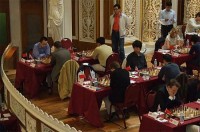 The city of Liverpool was founded in 1207 as King John issued letters patent to announce the foundation of the borough of Liverpool. Thus in 2007 the city celebrates its 800th birthday. From September 4th to 9th the city hosted a 800th Anniversary Summit Chess Match UK-China. Teams of six male and two female players competed in a Scheveningen-style match.The rate of play was all moves in 2 hrs plus 30 seconds per move. The English team included both Michael Adams and Nigel Short, the first time for almost 20 years that the two have played together in an event on British soil. The Chinese team included top stars Wang Yue, Bu Xiangzhi and Ni Hua, plus 13-year old schoolgirl sensation Hou Yifan. Alongside the match, there was also a nine-round International Open, with a prize fund in the region of £10,000-£12,000.
China defeated the UK team by an emphatic 28 points to 20. The decisive factor was undoubtedly the Chinese players' tenacity and staying power. UK team captain Jonathan Speelman commented in his speech at the Closing Ceremony that "(...) had the match been using that revolting English custom of adjudicating the games after four hours' play, the final result would have been a lot closer!" Indeed it would - time after time, the British players saw precious half points slip through their fingers in the fifth and six hours' of play, as the pressure of the time-limit, plus the incredible staying power and resourcefulness of the Chinese players proved too much.
The guest of honour at the Closing Ceremony was Mr Gong, the Consul-General at the Chinese Consulate in Manchester.
The open tournament saw victory of German GM Daniel Fridman (7/9) who came ahead a group of seven, of which podium placed were taken by GM Berg (Sweden) and GM Dgebuadze (Belgium) - 6.5/9 both.
UK (20p): GM Adams 3.5, GM Short 3, GM Rowson 1.5, GM Pert 1.5, GM Jones 2.5, GM Howell 2, IM Arakhamia-Grant 6, IM Houska 2
China (28p): GM Wang Yue 4, GM Wang Hao 4, GM Zhang Pengxiang 4, GM Bu Xiangzhi 3.5, GM Ni Hua 4, WGM Hou Yifan 2.5, WGM Shen Yang 6, WFM Ding Yixin 3.5
see tournament's homepage
see ChessBase report
/ taken from www.chessbase.com /
India crowned as World Youth Champions in Singapore
Posted by Webmaster on 19 Aug 2007
 August 11, 2007 was the day of a historic triumph of Indian squad, who won first ever World Youth Olympiad gold for their country in a 12-year long history of the event. The growing popularity of the World Youth U16 Olympiads drew 34 teams from 24 countries to Singapore, where 12th edition took place. The level of play was decent (3 IMs and a number of other titled players) although vast majority of European countries failed to arrive. Two by far strongest teams were India and Hungary.
The tournament victory was decided on round 5, when India hammered the Hungarians with a thumping 3.5-0.5 to retain the lead despite of unexpected 3-1 loss to the Philippines in round 7. The Hungarians, who had very bad time in the middle of the tournament took silver after impressive final spurt. The Filipino team comprised of 13-year old prodigy IM Wesley So (Elo 2516) and three unrated newbies. So's fantastic 9.5/10 supported by very good play of the rest of boys let the team take sensational bronze. Third seeds Australia took fifth place as sort of consolation.
India's success was fully deserved (despite poor loss vs the Philippines) and all five members of the team contributed to the overall victory. The victorious Indian team comprised of IM Adhiban, Ashwath, FM Nitin, Shyam Nikhil and Swayams Mishra.
Next Olympiad is scheduled in Turkey in 2008.
see Olympiad report at olimpbase.org
see full statistics at chess-results.com
see World Youth U16 Olympiads overview
9th All-Africa Games: the titleholders going strong
Posted by Webmaster on 12 Aug 2007
 Egyptian men's and Algerian women's teams were capable of defending their gold medals from 2003 in the African team chess competition that recently concluded in Algiers, Algeria.
Although chess became part of the All-Africa Games (African Olympics) only in 2003 the tournament is the only African team event (the Continental Championship hasn't been played for quite a while) and also the World Team Championship qualifier. Due to time shortages this is rapid chess tournament.
There was no surprise in men's event, which was a 13 team round-robin. Mighty Egyptian team led by IM El-Gindy won 11 matches and drew one to take first place (40/48). South Africa came second and Zambia were third, as in 2003.
There women's top three from previous Games changed by no means: Algeria (led by H.Toubal) took gold, while South Africa finished as runners-up. Nigeria won third spot. Botswana, who produced pathetic 0/36 at recent World Team Championship came in fourth place. Egpyt, the newcomers, gave remarkable start, i.e. beating South Africa 3-1, to deny their dreams about gold.
The 10th All-Africa Games are due in Lusaka, Zambia in 2011. Chess will most probably be the part of the games too.
The organisation and the coverage was very bad. The web site is not very legible and unstable. There are no game scores anywhere (can anybody help maybe?). Also, there is really very little information on the issue.
OlimpBase result& info pages: men, women
9th All-Africa Games home page
The Chess Drum blog - 2007 All-Africa Games topic
Powered by CuteNews