Anand to lead India in Calvia!
Posted by Webmaster on 23 Sep 2004
 World rapid chess champion Viswanathan Anand will lead India in the men's section of the Chess Olympiad scheduled to be held in Madrid, Spain from October 14.
 This is the first time that an all-Grandmasters team is representing India. Anand is playing in the Olympiad after a long gap of seven years and the man believes that despite having a good team, it won't be smooth sailing for India in the competition.
The Chess wizard has won almost everything that has come his way, including his third Chess Oscar and has already bagged three major titles this year- the Corus Super Grandmaster's title, the Dortmund Championship and the Mainz Classic.
Anand, who is touring various Indian cities to promote the game, made time for some school children in the capital on Thursday. Twenty-one students from Delhi's Vasant Valley School got an opportunity to play their moves against the world rapid chess champion.
Originally cited by Sun Network
OlimpBase Quiz #2: Olympic Scandals
Posted by Webmaster on 13 Sep 2004
 We have prepared a set of five Olympic knowledge quizzes for you, with 10 questions and 50 answers each, of which only 10 answers are correct. Are you ready to shoot the perfect 10 of each Quiz? Today we start with the first Quiz: The Olympic Scandals. Ten scandalous events from the history of the Olympiads were recalled. Each of them has been supported with 5 hypotheses, four false and a true one. Your job is to extract a drop of a truth from the ocean of lies. Enjoy!
OlimpBase Quiz #2: The Olympic Scandals
Calvia Mania begins! Bigwig preview
Posted by Webmaster on 07 Aug 2004
 It's no more than 10 weeks until the start of the 36th Chess Olympiad held in Calvià, Spain. It is high time we focused entirely on the forthcoming event. We promise to do our best to provide you with most complete historical coverage of 1976-2002 period before Calvia take-off (however you can never know, if you can help, then do help). Who is going to take the Gold? Who is able to reach the medal zone? The July ELO ranking list is already at our disposal at www.fide.com. Here is the top 6 according to average ELO of top ten of each nation:
| team | ELO | top players |
| 1. Russia | 2721 | Kasparov 2817, Kramnik 2770, Morozevich 2743, Svidler 2727 |
| 2. Ukraine | 2632 | Ponomariov 2722, Ivanchuk 2715, Moiseenko 2640, Volokitin 2638 |
| 3. Hungary | 2624 | Leko 2741, Polgar 2728, Almasi 2644, Gyimesi 2618 |
| 4. USA | 2610 | Onischuk 2655, Seirawan 2631, Goldin 2624, Kaidanov 2621 |
| 5. England | 2609 | Adams 2738, Short 2684, McShane 2643, Sadler 2617 |
| 6. France | 2608 | Bacrot 2712, Lautier 2666, Fressinet 2637, Tkachiev 2615 |
Russia seem to be favourites but who of the world's top players is going to visit Calvia? There will certainly be some major absentees like Kramnik and Anand. Who else?
Discuss at our forum , answer the poll question there and share your opinion with other users. Bet your dark horses, scorn the favourites. Who the Peonin, the Calvia mascot, will be lucky for? Is anyone able to predict top three?
Discuss at our forum , answer the poll question there and share your opinion with other users. Bet your dark horses, scorn the favourites. Who the Peonin, the Calvia mascot, will be lucky for? Is anyone able to predict top three?
OlimpBase is fully recovered after server being down for dreadful fortnight!
Posted by Webmaster on 05 Aug 2004
 More than two weeks ago we have suffered unexpected and awful server collapse. Unfortunately some data, namely Guestbook, Newsletter and Forum registers were lost forever. You are welcome to re-enter them. Our new server should be much faster and more reliable. Please let us know about errors or any inconvenience encountered.
Looking for OlimpBase correspondents
Posted by Webmaster on 01 Aug 2004
 It is time to enlarge OlimpBase Team a little bit. So far we have few dozens of people but we need more. Currently we are looking for OlimpBase correspondents. We need at least one correspondent from each country. To be an OlimpBase correspondent means that you will get your own username and password for our News script and you will, or will not, occasionally post Olympic news related to your country's team. There are no limits of your activity. Post one message a week if you like. Or you may post one message in 2 years, or less. We will accept all. Apart from that we need people who would take care about players' biographies from chosen country. They should be written in decent English and should not be bigger than 10 kB. You do not need to send biography for each player from your country, although this would be nice to see. They need to be send in a plain text to us. No time limits are set. Finally, we are looking for people who would generously send us players' photos, 150x210 jpeg format is preferable. Please do not forget copyrights, the owner must always agree to use the photos.
Please do not forget to give your valid email address so that we could contact you.
Let's shed some light on unofficial Olympic events
Posted by Webmaster on 29 Jun 2004
 The History of the Olympiads is more than just listing of official Olympic events. The Olympic history has many unknown yet fascinating threads, some of them worth deeper analysis. Today we bring you the data concerning first unofficial Chess Olympiad held in conjunction with Paris 1924 VIII Summer Olympic Games. This is even more important since the event was concluded with settling International Chess Federation (FIDE).
 Apart from these we believe that infamous Anti-Israeli "Counter Olympiad" held in Tripoli in 1976 (yes, same Libya and same Gathafi as in 2004!) is also part of history worth at least quick look.
The information on the "Little Olympiad" held in Budapest 1926 has been a little bit extended as well. This tournament has everything that official Olympiad should have, except the number of teams participating (just 4).
As usual you are asked to support our efforts with additions and corrections of our data. Enjoy!
Paris 1924 Team Chess Tournament
Budapest 1926 "Little Olympiad"
Tripoli 1976 Anti-Israeli "Counter Olympiad"
Greek Olympic Team News
Posted by Chrysafis Stamoudis on 14 Jun 2004
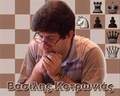 GM Vassilios Kotronias finally returns to the Greek Olympic Chess Team. GM Kotronias was the highest rated Greek player when he argued with the Greek Chess Federation, an argument that lead him to join the Cyprus National Team. Kotronias played first board in the Cyprus Team in every Olympiad and European Team Championship ever since. But now the argument has been solved and the top Greek GM seems ready to return and lead the Greek team to greater achievements. Kotronias was born in 1964 in Athens, and has won the Greek championship 7 (!!) times. He obtained the GM title in 1990 and he is the first ever Greek to pass the 2600 FIDE rating (info by www.skaki.gr and www.chess.gr)
Olympic Heroes: Isaías Pleci
Posted by Webmaster on 30 May 2004
 Born in 1900, he originated from Argentina. Pleci used to say that once he had a chance to play against great chess players he realized how poor his theoretical background was. Perhaps this was not far from reality. Moreover he was never a player with thorough positional outlook which was another serious handicap for him. How come then that the lucky star shone over his head throughout his Olympic career? One has to stress that contrary to the popular image of Pleci as an offensive player - he even earned a nickname "the tank" - the observation of his Olympic games shows it otherwise: he was cautious in the openings and lacking initiative, sometimes showing less technical skills than his partners.
 Where did his strength come from then? From the endgames. The endings and the stage of the game that we used to call the pre-endgame, gave ample compensation for other phases of the game. He had reliable instinct about when and how to simplify the position, and his rivals must often have been surprised when the "frightful attacker" went on for series of trades heading towards seemingly even position where he found tiny yet stable advantages. Sometimes he had a chance to conduct a mortal counterstrike biting from the back ranks the exposed pieces of his enemy.
It might be argued that his enormous successes came from the fact that he used to play at 3rd and 5th board at the Olympiads (the difference between the boards used to be much larger in the past). But there comes an interesting anecdote in this respect. (this is most probably vague story yet still interesting to hear; W.B.) In Warsaw, 1935, Pleci, Argentina's board #3 lost couple of games in the middle of the tournament. Grau, the team captain, decided to put him at board #1 (team Argentina had no reserve players), since in there was no strict board order those days (there was, since 1931! W.B.). The reason was clear: the reserve player was likely to be defeated at top board yet the rest of the team were facing weaker opposition enhancing their chances for earning more points. However Pleci surprisingly started to play much better and defeated a few well-known players. Isaías Pleci is being known as an aggressive, risky, tactical player. We do not think this is correct. The well-known Pleci-Endzelins game (Argentina-Latvia, Buenos Aires 1939 Olympiad), that became famous around the world, is an exception among others. He earned his nickname "Tank" simply because he was the winner, not because he was a master of tactics.
He made his first chess steps at the Círculo de Ajedrez ("Circle of Chess") club in Vélez Sársfield, but most of the time he played for "Jaque Mate" ("Checkmate") Chess Club. He participated in a couple of Argentina Championship's qualifiers until he finally qualified for the main final ("Torneo Mayor") in 1928. He qualified for the final round soon but he lost the match for the title against Grau by 0-4. He took fierce revenge on the next year beating Grau by 4-2 and earning well-deserved title of the Champion of Argentina. As a Champion of Argentina he was invited to take part in the international tournament in Liège (Belgium), 1930. Series of unlucky circumstances - we do not mention his partners' skills here - caused biggest disaster of his international career, as he came last. After having returned to Argentina he defended his title defeating Fenoglio in a final match but then he was beaten twice by Jacobo Bolbochán who made enough effort to get familiar with secrets of positional play. He went back to Europe in 1935 to play for his home country at the Warsaw Olympiad in Poland. He also played in Stockholm, 1937 and at the home soil in 1939, of course. He has superb overall Olympic performance of 41/55 (75%) and he won two medals for his individual performance (bronze in 1937 and gold in 1939). Another memorable achievement of him was the first prize won at the international tournament in Mar del Plata, 1936.
Pleci became frequent visitor at "Círculo de Ajedrez" Chess Club in Villa del Parque once they moved at San Blas St. 3425, just a few minutes from Pleci's house. He obviously enjoyed these visits. He truly enjoyed giving lessons to young and talented chess players, and although some people recognized his attitude a little bit conceited he had gentle and mild personality in fact. One of his club-mates told us about his last visit to the club (this was in 1980). On the following day he had to go to the hospital. He felt that his illness was mortal. He wandered slowly through the club halls, absent in soul, casting hazy glances at all the tables, all the walls, all the pictures. Then he left the club without speaking to anybody...
Here are two of his classical, dazzling wins:
Eliskases - Pleci 0-1, Warsaw 1935 Olympiad
Pleci - Endzelins 1-0, Buenos Aires 1939 Olympiad ("la inmortal Argentina")
/Based on "Nuestro Círculo" bulletin no. 76, translated and revised by Wojciech Bartelski/
Powered by CuteNews