European Team Championship round 2
Posted by Webmaster on 03 Aug 2005
 As early as in round 2 the top matches are very tight already. Russia halved vs Azerbaijan at top table (all faour games were drawn). Avrukh led Israel to a win over Hungary beating Ruck nicely (see below for the game). Ukraine sensationally lost to Holland as Timman beat Kuzubov , and don't forget that Jan will soon turn 54 while Yury is still a teen (15)! France, led by superb duo Bacrot and Lautier ran over the Czech Republic and Germany beat England. Sweden, the leaders beat Serbia while Armenia hammered Sweden "C" by a ruthless 4-0.
 In the women's section Russia beat Serbia, Hungary lost sensationally to Greece 3-1, Armenia beat Holland and the rest of the pairing, including Poland-Georgia and Ukraine-Bulgaria (Stefanova beat Lahno) were drawn.
Leaders in men's competition: France, Israel, Holland, Germany and Sweden; in women's: Romania, Russia, Armenia, Greece (and poor Swiss girls lost both matches 4-0!).
 Avrukh (ISR, 2652) - Ruck (HUN, 2546)
Black chose one of minor lines of Grunfeld of dubious reputation. Indeed, his pieces quickly lost coordination leading to some positional disadvantages and material loses. See how quickly White destroys Black shield. 27. e6! before this move was made, would you guess the black King's position is vital? 27. ... Rxc8 28. exf7+ Qxf7 29. Qxc8+ Kg7 30. Re6! now Black cannot stop white Rook from its way to c7. Rc1 was quickier but easy to refute with Nc5 30. ... Nc5 31. Rc6 Qf8 32. Rc7+ Kg8 33. Qh3! resigns. Mate on h7 can only be avoided at a cost of a Queen. Impressive mobility and coordination of White pieces.
 Kortschnoj (SUI, 2615) - Nisipeanu (ROM, 2679)
The legendary veteran Kortschnoj and young Romanian fought hard until the Rook ending emerged from complex middlegame. While Nisipeanu greedily stole all of white Kingside pawns Kortschnoj focused on his "b" file pawn that was finally killed in a suicidal run of black Rook. The ending is drawish, but let us see how it all worked: 38. ... f5 39. Kc6 g5 40. Kc5 perhaps Rd5 was a better choice first! 40. ... Ke5 41. Kc4 Ke4 42. Kc3 h5 43. Kd2 h4 44. Ke2 g4 and white King is where it should be but the chain of black pawns progressed, securing a tie. 45. Ra4 Ke5 46. Ke3 h3 = White can easily take f5 in which case he loses immediately because of "h" pawn promotion. On the other hand black chain of pawns is blocked.
 Antoniou (CYP, 2198) - Kozul (CRO, 2585)
GM Kozul must have probably taken his amateur opponent too easy. The game was hard fought but Black's threats at white Kingside must have looked dangerous for White. Antoniou missed a chance of his life. To justify him, the way to win was not obvious. White was winning after 34. Rb6! Kg6 (to avoid pin) 35. Bxe6 Kh7 36. Bxf5+ Kg8 37. Qd5+ Kf8 38. Rg6 or 35. ... Kh5 36. Bf7+ Kg4 37. Rd4+ f4 38. Rg6. Instead he played 33. Rdc7? a3! 34. Bb5?? still 34. Qxa3 Kf8 35. Qc3! Qf6 36. Qxf6 Bxf6 37. Rf7+ was winning 34. ... Ra1!! a thunderstruck! 35. Kb3 axb2 36. Bxe8+ Kf8! resigns. Not every day we see a 2200 player so close to defeating a 2600 GM...
European Team Championship round 1
Posted by Webmaster on 02 Aug 2005
 Round 1 usually sees the big-wigs playing the minnows and not many matches are the close run. However here, with just 40 teams and most of them being quite strong there are few that will be easy to defeat. Russia, seeded as no. 1, beat Croatia at board one, but only by the smallest possible margin and Motylev lost badly to Palac. Ukraine beat Spain 3-1 despite Karjakin's loss. Armenia, 4th seeds, drew (remember that match points matter!) vs Lithuania in a four tie match. France hammered Estonia by 3,5-0,5 and we saw emmaculate technique that led Bacrot to an instructive engame win vs Kualots. Georgia with Azmaiparashvili and Jobava, the Calvia hero, barely halved vs Sweden "C" (sic!). Sweden "A" were lucky enough to be seeded in 20th which made possible for them to face Cyprus, by far the weakest of all teams (and, remember, Kotronias plays for Greece now) and were the only team to win with a clear 4-0.
In women's sections, where the matches were for the very first time played at 4 boards, all of seeded teams won. Germany took the lead after 4-0 over Switzerland. Russia and Georgia, top seeds, won their matches 3,5-0,5. Poland and Ukraine dropped 1,5 (but no match point!) vs the Czech Republic and Sweden "A" respectively.
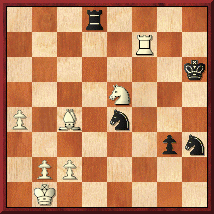 Motylev (RUS, 2675) - Palac (CRO, 2566)
Motylev conducted brave Queenside attack in a Sicilian Najdorf. The Black refuted the threats but at the cost of a pawn and chain of three free white pawns at the Queenside. The ending looked well for White but suddenly one of black pawns took one or two steps forwards and suddenly faced promotion. In the diagram position 38. Bf1 leads to a draw: 38. ... Nd2+ 39. Kc1 Nxf1 40. Rxf1 g2 41. Rf6+ Kh5 42. Rf5+ Ng5 43. Nf3 Kg4 44. Rxg5+ Kxf3=. Instead White played 38. Ka2? and lost after 38. ... g2 39. Nf3 Ng5 40. Nh4 act of desperation 40. ... g1=Q 41. Nf5+ Kg6 42. Ne7+ Kh6 43. Nf5+ is it a perpetual check? 43. ... Kh5 of course not. White resigned.
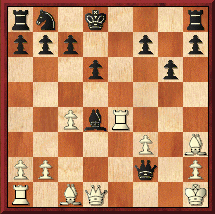 Moiseenko (UKR, 2664) - Lopez Martinez (ESP, 2507)
Seemingly position looks well for Black. He infiltrated white King's position and is two pawns ahead. But in fact he is almost lost already because of underdevelopment of his Queenside pieces and almight pair of white Bishops. 17. ... Bf6 in order to prevent Bg5+ 18. Be3! Qxb2 19. Rb1 Qc3 20. Qd5 Nc6 what else could be done here? 21. c5! Be7? loses immediately, but there was no rescue 22. cxd6 resigns.
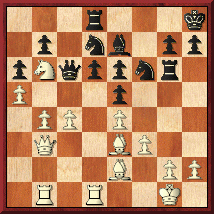 Perez Candelario (ESP, 2504) - Karjakin (UKR, 2645)
The wunderkind from Ukraine is clearly in trouble. The e6 pawn is permanently weak and coordination between Queenside and Kingside is poor. White has pair of Bishops and good attacking chances. Look in how tricky way Perez converts these positional advantage into a clear win: 22. ... Nxb6 23. b5! Qc8 24. bxa6! the Knight still under attack 24. ... bxa6 25. axb6 Qb7 26. c5! and game over... 26. ... dxc5 27. Rxd8 Bxd8 28. Bxc5 despite the material balance the "b" pawn costs a piece, and in fact it did on White's 39th move. The game was 73 moves long though and an unusual ending RBBvQ took place. 1-0
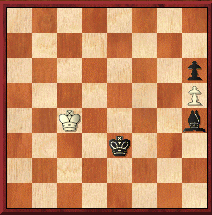 Kulaots (EST, 2570) - Bacrot (FRA, 2729)
Can Black win this position? He has huge material advantage but because of "bad" Bishop a simple plan of taking ph4 fails. So his primary task is to push white King far from the key corner to pave the way up for black pawn. If took Bactor as much as 41 moves to complete the task! Detailed analysis of this ending is probably a challenge for a few weeks for a team of world's top GMs, so we will not analyse it here. The zugzwang position was: white Kb1; black Kd1 and Bd4; White's move. After forced 120. Ka2 black King simply stole the pawn and Bd4 blocked white King's way info the corned through h1-a8 diagonal.
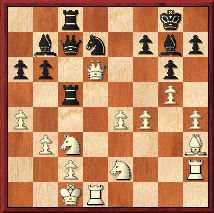 Olsson (SWE2, 2416) - Babula (CZE, 2604)
The position is complex and both sides have all kinds of attacking chances. 25. ... Rxc3! the only move. Qxd6 loses because of Rxd6 and a pin on Nd7 26. Nxc3? loses immediately. 26. Qxc7 R3xc7 27. Rxd7 Rxc2+ 28.Kd1= was the only choice 26. ... Qxc3 27. e5 perhaps hoping to annihilate black Bishop, but.... 27. ... Nc5? oups! he missed a win in one move, namely Bf8!! Now White stays alive, although not quite fit. 28. Kb1 Nxb3 29. Ka2 Bf8? too late now! Nc1+ Rxc1 Rc4 was decisive 30.Qd3? better Qxb6 30. ... Nc1+ 31. Rxc1 Qxd3 32. cxd3 Rxc1 -+ White resigned soon and the game must be called "a blunder comedy". The zeitnot at both sides is not an excuse.
The European Team Championship is on the way!
Posted by Webmaster on 02 Aug 2005
The European Team Championship celebrates these days its jubillee of 15th edition yet it is as old as 48 years, as the very first edition was held in 1957. It used to be round robin event but since 1989 the overwhelming Swiss Sytsem is in use. Unlike the Olympiads the distance is 9 rounds and the Match Points are major tie-break (which, by the way, dramatically affects the nature of the competition).38 teams in open event and 25 teams in women's event will apeear in Gothenburg, Sweden, which hosts the 2005 Championship. Among them many world's top players like Ivanchuk, Svidler, Bacrot, Lautier, Akopian, Karjakin, McShane and others. Russia are top seeds with average ELO of 2692 ahead of Israel (2659) and Armenia (2653). Other teams aiming at reaching medal zone are France, Ukraine, Poland, Holland and Sweden (yep!).
We will provide you with daily reports including game overview and highlight preview, so stay tuned! Moreover, within a week we will provide you with a complete history of the European Chess Team Championship (both men and women), with every game, every player and ever result available online one click away from you!
Please don't forget the must links:
http://www.goteborgchess2005.se - Championship Official page. Includes results, games, photos, comments and more.
http://schach.wienerzeitung.at/asp/turniereET.asp?tnr=2498&lan=1 - Official results page. Includes detailed results, rankings, statistics.
http://www.chessbase.com - daily reports with results, photos and links, including IM Aagaard's daily audio analyses in the Broadcast room at Playchess (available for guest users as well!)
How Lawrence Day beat himself
Posted by Webmaster on 13 Jul 2005
by David Cohen
 When I mention a chess player beating himself, I probably conjure up an image of Geri, the lonely geriatric chess player in the park, from the Academy Award winning animated short film from Pixar, "Geri's Game". Geri ran around the board making the moves of both players. But no, this is the mystery of the Canadian Team at the 1974 Nice Olympiad.
My researches into Canadian chess history started simply enough. I wished to compile a listing of our Olympiad results, including individual scores. The 1974 Olympiad was the last before Canadian International Arbiter Phil Haley introduced the Swiss pairing system at the 1976 Haifa Olympiad. Back in 1974, a system of round robins was still in use. In the preliminary, Canada placed =3rd and was relegated to the Group 'B' finals with 15 other teams. Here my (chess history) troubles began.
When I totalled up the players' scores from the database of Canadian Olympiad games on Hugh Brodie's Montreal Chess web site, I was 0.5 points short. Chess Canada 1975.07-08, p.44, provided the explanation: Canada's result against the other team from its preliminary group, Denmark, was carried over. Canada scored 0.5 points against Denmark. So, Canada scored 30.5 points against the remaining 14 teams in the Group 'B' finals, for a total of 31 points and an 8th place finish (24th overall).
But now comes the real mystery. In his Toronto Star column of 2004.01.31, IM Lawrence Day stated that Day - Asmundsson, Canada - Iceland, 1-0 is the correct colours. He expressed his frustration that databases around the world contained the game with the colours reversed, giving it as Asmundsson - Day, 1-0. I consulted the Canadian DB, and, sure enough, the DB had the wrong colours. But when I reverse the colours, then Canada should score one more point! What happened?
I investigated the players' colours. With 14 teams to play, Canada would have had 7 Whites and 7 Blacks. Checking in the DB for the colours on Board 1 in each match revealed 7 Whites and 6 Blacks in the 13 other matches. So, Canada played Black against Iceland. This meant that Canada was Black on Board 1, and alternated colours on succeeding boards.
Board 1 was a draw:
Fridrik Olafsson - Duncan Suttles
Iceland - Canada, Olympiad Finals Group B, Round 2, Nice 1974
1.d4 d6 2.e4 g6 3.Nf3 Bg7 4.h3 Nf6 5.Nc3 0-0 6.Bg5 c5 7.dxc5 Qa5 8.Bd3 Qxc5 9.0-0 Nc6 10.a3 Be6 11.Qd2 Rfc8 12.Rfe1 Qa5 13.Bh6 Ne5 14.Nxe5 Bxh6 15.Qxh6 Qxe5 1/2-1/2
The next two players in board order, Peter Biyiasas and D. Abraham Yanofsky, did not play this round.
Board 2 saw a game (published in Chess Canada 1975.07-08, p.45-7, with annotations by Kuprejanov) that was in the winner's words "extremely tense and nervous":
George Kuprejanov - Gudmundur Sigurjonsson
Canada - Iceland, Olympiad Finals Group B, Round 2, Nice 1974
1.e4 c5 2.Nf3 d6 3.Bb5+ Nc6 4.0-0 Bg4 5.h3 Bh5 6.c3 a6 7.Bxc6+ bxc6 8.d4 cxd4 9.cxd4 e6 10.Nc3 Be7 11.Qa4 Qd7 12.Nh2 d5 13.Be3 Bd8 14.e5 Ne7 15.Qa3 0-0 16.g4 Bg6 17.Na4 a5 18.Rfc1 Rb8 19.Qc3 h5 20.b3 Rb5 21.Nc5 Qa7 22.Rf1 Bb6 23.Na4 Bc7 24.Rac1 Rb4 25.Rfd1 Bb8 26.Nf3 hxg4 27.hxg4 Qc7 28.Ng5 Ba7 29.f3 Qc8 30.Nc5 Rb5 31.a4 Rb4 32.Nd3 Rb7 33.Nf4 Qb8 34.Nxg6 Nxg6 35.Rd3 Qd8 36.f4 Rb4 37.Kg2 c5 38.Qe1 cxd4 39.Qh1 Re8 40.Bd2 Rb7 41.Qh7+ Kf8 42.Rc6 Qb8 43.Nxe6+ Rxe6 44.Rxe6 Rxb3 45.Rxg6 fxg6 46.Qh8+ Kf7 47.e6+ Kxe6 48.Qxg7 Rb2 49.Qxg6+ Kd7 50.Qf7+ Kc6 51.Qe6+ Kc5 52.Qe7+ Kc4 53.Qe2 Kc5 54.g5 Qxf4 55.Bxf4 Rxe2+ 56.Kf3 Re8 57.Rd1 Kc4 58.Rc1+ Kd3 59.Rb1 Bc5 60.Rd1+ Kc3 61.Rc1+ Kb4 62.Bd2+ Kxa4 63.Rxc5 Kb3 64.Bxa5 1-0
In the normal course of events, Canada would play Black on Board 3. But Lawrence has the original scoresheet to prove that he played White! I believe Lawrence played the wrong colour on his board. Piasetski, sitting next to him, probably alternated his colour from Lawrence's, and thus played the wrong colour as well. Technically, this was possible if the players at Boards 3 and 4 were seated apart from the top two boards. (It was also possible if Canada's players on Boards 3 and 4 switched with each other.) However the switch happened, it was the responsibility of the two team captains.
My theory on how the switch happened must be placed into the context of the tournament. First, all reports I've read suggest that the organization of the tournament was chaotic. Round bulletins (and, I understand, the subsequent book based on them) were incomplete or full of errors. Second, Canada did not have a team captain!
Here is the Board 3 game, which followed Lawrence's home preparation:
Lawrence Day - Ingvar Asmundsson
Canada - Iceland, Olympiad Finals Group B, Round 2, Nice 1974
1.e4 e6 2.d3 d5 3.Nd2 Nf6 4.Ngf3 b6 5.Be2 Bb7 6.e5 Nfd7 7.0-0 Be7 8.Re1 Nc6 9.Bf1 g5 10.h3 h5 11.g4 hxg4 12.hxg4 Nf8 13.Bg2 Ng6 14.Nf1 Nf4 15.d4 Kd7 16.Bxf4 gxf4 17.Qd2 Bg5 18.c4 Na5 19.b3 Qg8 20.c5 Ba6 21.N1h2 Qg6 22.Rac1 Rac8 23.Qb4 Bd3 24.Qc3 Ba6 25.c6+ Ke7 26.b4 Rxh2 27.Kxh2 Rh8+ 28.Kg1 Nc4 29.b5 Bc8 30.Qc2 Qg7 31.Kf1 Bh4 32.Nxh4 Rxh4 33.Bf3 Rh3 34.Kg2 Rh4 35.Qe2 f6 36.exf6+ Qxf6 37.Rh1 Rxh1 38.Rxh1 Qxd4 39.Rd1 Qe5 40.Qxe5 Nxe5 41.Rh1 Ng6 42.g5 a6 43.Rh6 Nf8 44.a4 axb5 45.axb5 d4 46.Bg4 Kf7 47.Rf6+ Kg7 48.Bh5 e5 49.Rf7+ Kg8 50.Rxc7 Be6 51.Re7 Bd5+ 52.Bf3 Be6 53.Rxe6 Nxe6 54.Bd5 Kf7 55.c7 1-0
And now the real troubles started. Lawrence reported the results of the game as it was PLAYED - but the organizers must have recorded the result as it was ASSIGNED. So, Canada - supposed to be playing Black - lost the game on Board 3. Lawrence had beaten himself!
Board 4 was a draw:
Bjorgvin Viglundsson - Leon Piasetski
Iceland - Canada, Olympiad Finals Group B, Round 2, Nice 1974
1.e4 e6 2.d3 d5 3.Nd2 Nf6 4.Ngf3 Nc6 5.g3 dxe4 6.dxe4 e5 7.Bg2 Bc5 8.0-0 0-0 9.c3 a5 10.Qa4 Bd7 11.Qc2 Re8 12.h3 b5 13.Kh2 a4 14.Rb1 Ra6 15.b4 axb3 16.axb3 Qa8 17.b4 Bb6 18.Qd3 Ra1 19.c4 1/2-1/2
Because the point was split, the colour switch had no effect here.
Now we can see how Lawrence's game came to enter the databases with the colours reversed. Going by board order, the assigned colours and game results, editors - without accurate round bulletins to refer to - concluded that Lawrence must have played Black on Board 3 and lost the game. Strangely enough, the database of games from France has Canada playing Black in three of the four games! Lawrence's game is reversed, in order to match the posted result, while Piasetski's game is recorded with him also playing Black. The Canadian database maintains the 2 Whites to 2 Blacks ratio by also reversing the colours on the Board 4 game, thereby showing Piasetski as playing White.
In conclusion, Canada should have scored one more point and finished =5th in Group 'B' (21st overall). Finally, I have also answered the question: if you beat yourself, is the game scored a win or a loss? In Lawrence's case, it was scored a loss, but he had other matters to attend to - he was on his honeymoon.
---
References
Lawrence Day, chess column in Toronto Star 2004.01.31 and personal correspondence
Chess Canada 1975.07-08, Volume 5 published by Vladimir Dobrich, edited by Robert Rubenstein
Hugh Brodie's Montreal Chess web site and Canadian games DataBase
Eric Delaire's DataBase of games from France
David Cohen is a graduate of Yale University School of Management. He is a chess teacher, as well as a FIDE International Arbiter and long-time chess organizer. He has written extensively about the game, including three volumes of chess teaching materials and many articles about the history of chess in Canada. You can contact him through his website on Canadian Chess: http://www.ncf.carleton.ca/~bw998/canchess.html
Written and copyright 2004 by David Cohen. Originally published 2004.03.15 Scarboro Community Toronto Chess News & Views electronic newsletter. Reprinted by permission of the author.
World Chess Team Championship history
Posted by Webmaster on 09 May 2005
 The World Team Championship was established in 1985 and is being held in four year cycles. Due to high volatility of the Swiss system adopted at the Olympiads the WTCh was scheduled to be a one group round robin. Only ten teams qualify: the host team, the continental champions and top teams from recent Olympiad are eligible to participate (with some exceptions like invitations for women teams or wild cards granted by the organizers).
The WTCh is not a very spectacular event and many top players find every excuse not to arrive. This is perhaps one explanation why USSR/Russia hasn't dominated the pool to the same extent as seen at the Olympiads. However, since there is very few information on the topic available at the Web we decided to fill this gap with Olympiad-like, excessive coverage of all the events. This is a unique meeting of top teams and a crown of the Olympic cycle after all.
The World Team Championship was first planned to be held in Lucerne every four years but recently this rule has been dropped. The next WTCh is scheduled to be played in Israel in late 2005. Teams qualified so far: Israel, Ukraine, Russia, Armenia.
Please find most complete history of the World Team Championship and the statistics - all in the well known OlimpBase format: http://wtch.olimpbase.org
Mario Serracino-Inglott reminisces memorable Malta Olympiad
Posted by Webmaster on 08 Apr 2005
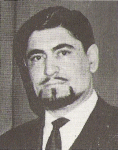
 "Malta was rewarded to host the 24th Chess Olympiad for its efforts to maintain unity and peace within the FIDE, following the successive Haifa events and the shuttle peace talks by Malta's representative between the late Harry Golombek (UK) and Libya where the Counter Olympiad had taken place. This was the first time ever that the greatest chess-team manifestation, the 1980 Olympiad, was held in such a small state with a limited budget but nonetheless a great history. (...)"
 Read full text here.
Mario Serracino-Inglott was the head co-organizer of 1980 Olympiad along with Pisano Rossi. Aged 10 he was the youngest ever Junior Champion of Malta. Although he never commited himself to a professional chess career he used to be a true spiritus movens of Maltese Chess. His workoholic lifestyle caused him major health problems that forced him to retire from chess world. Last years he became eminent member of Maltese community devoting himself to popularizing knwledge of Maltese language (he used to be a vice-president of Akkademja tal-Malti) and history, as he wrote a book on three ancient Maltese cities, Vittoriosa, Senglea and Cospicua.
OlimpBase Quiz #3: Olympic Players
Posted by Webmaster on 05 Apr 2005
 We have prepared a set of five Olympic knowledge quizes for you with 10 questions and 50 answers each, of which only 10 answers are correct. Are you ready to shoot the perfect 10 of each Quiz? We believe all of you have already taken the startup Quiz (The Olympic Scandals, try here). Today we continue our historical voyage with another Quiz and this one is devoted solely to the player-related issues. Ten questions from the history of the Olympiads were asked. Each of them has been supported with 5 hypotheses, four false and a true one. Your job is to extract a drop of a truth from the ocean of lies. Enjoy!
OlimpBase Quiz #3: The Olympic Players
Olympic Heroes: Garry Kasparov
Posted by Webmaster on 16 Mar 2005
 He was born in Baku (Azerbaijani Soviet Republic at the time) on April 13th, 1963 as Harri Weinstein, from Armenian mother and Jewish father. He first began the serious study of chess after he came across a chess problem set up by his parents and proposed a solution to it. When he was 7 his father died and he adopted his mother's surname as soon as was legally possible at the age of 12. His mother's nee was Kasparian and "Kasparov" is the Russianized version of it. He attended famous Botvinnik's chess school and won his first title at Soviet Junior Championship in 1976, aged 13. In 1978 he became a master and decided to commit himself to a professional chess career. His first published ELO ranking was 2595 (in 1979) after excellent performance at GM tournament in Banja Luka.
In 1980 he won the World Junior Championship. On the next World Championship cycle he easily ran into the candidate phase where he ran over Beliavsky, Kortschnoj and veteran Smyslov respectively. In 1984 he faced "Red Tola" from Zlatoust, a Soviet GM Anatoly Karpov in a WCh match.
This one of most memorable WCh matches was set up as best of 11. Karpov took off with excellent 4-0 and it seemed near impossibility for Kasparov to recover even worse that Karpov scored fifth victory soon. But Karpov, having physically weak body, soon fell into serious endurance deficit and was close to total exhaustion. Kasparov made up for a part of a lost ground bringing the score to decent 5-3. Then the match was ended by Campomanes, the head of FIDE and a new match of 24 games was announced to start within a few months.
The second Karpov-Kasparov match in 1985 was quite even both in terms of standard of play and game results and Kasparov went on for a thumping win in the last game to win the match 13-11 and become the youngest ever World Champion at the age of 22. Within next few years he defended his WCh title three times against Karpov. The stand-off lasted until 1993 by which time a new challenger (Short) had qualified through the candidates cycle. Kasparov and Short decided to play their match outside of FIDE jurisdiction and went under auspices of PCA, a professional chess players' association newly created by both players. Kasparov defended his PCA title in 1995 vs Anand before PCA finally collapsed. In 2000 he organised another WCh match, this time under auspices of BrainGames though, and he lost to Kramnik. He played a number of human vs computer matches including a memorable loss vs DeepBlue in 1997 and a spectacular match vs X3D Fritz played at virtual board with use of 3D glasses.
Kasparov sustained his will on playing unification match under FIDE auspices but unfortunately this never came true. Meanwhile he won many major GM tournaments earning reputation of one of most brilliant geniuses in the history of chess.
In 2003 he edited the first volume of his monumental work Garry Kasparov on My Great Predecessors which he still is working on. The book became total hit winning the title of BCF Book of the Year 2003. His charismatic personality and often showed sense of leadership made it possible for him to exert huge influence on modern chess, both in terms of financial and analytical issues.
Garry Kasparov took part in eight Olympiads starting from Malta 1980 with a gap of 22 years between first and last Olympic game. He represented Soviet Union and Russia four times both and all of his appearances, six of them at board one, gave his team the overall win. Apart from that he won 11 individual medals, including 7 gold. In 1986 and 1988 Kasparov hit the jackpot with a pack of three gold medals, one for overall team performance, one for individual percentage performance and one for best performance rating.
He holds a thumping 64½/82 record with an overall percentage performance of 78.7%. He won 50 games, lost only 3 and drew 29. His last appearance at the Olympiads was in Bled, 2002 where he led Russia to a win achieving an incredible performance rating of 2940.
Thank you Garry for all the joy and magic that you have brought us.
Please do not forget your promise to take part at the Turin Olympiad.
See Garry Kasparov's full Olympic record sheet here.
/ Kasparov's bio was based on Wikipedia - the free internet encyclopaedia. /
KASPAROV'S MOST MEMORABLE OLYMPIC GAMES
| Kasparov - Lautier, Moscow 1994  28. Ng4! Resigns (28. ... Qe6 29. Rd8 +-; 28. ... Rxg5 29. Nxe5 Rxh5 30. Rd8+ Ng8 31. Nxf7#) | Kasparov - Nikolic, Manilla 1992  17. Nxg7! Kxg7 18. Qf5 Nf8 19. h4! h6 20. g4 Qc8 21. Qxc8 Raxc8 22. g5 += |
| Gheorghiu - Kasparov, Thessaloniki 1988  15. ... e4! 16. Nxh5 Nxh5 17. fxe4 f4! 18. Bf2 Bg4 19. h3 Bd7 20. 0-0-0 Be5 21. Kb1 Qf6 with attack | Kortschnoj - Kasparov, Lucerne 1982  17. ... b5! 18. axb5 axb5 19. Naxb5 fxe4! 20. Bxe4 Bd7 21. Qe2 Qb6 22. Na3 Rbe8 23. Bd2 Qxb2 with attack |
Powered by CuteNews