Let's shed some light on unofficial Olympic events
Posted by Webmaster on 29 Jun 2004
 The History of the Olympiads is more than just listing of official Olympic events. The Olympic history has many unknown yet fascinating threads, some of them worth deeper analysis. Today we bring you the data concerning first unofficial Chess Olympiad held in conjunction with Paris 1924 VIII Summer Olympic Games. This is even more important since the event was concluded with settling International Chess Federation (FIDE).
 Apart from these we believe that infamous Anti-Israeli "Counter Olympiad" held in Tripoli in 1976 (yes, same Libya and same Gathafi as in 2004!) is also part of history worth at least quick look.
The information on the "Little Olympiad" held in Budapest 1926 has been a little bit extended as well. This tournament has everything that official Olympiad should have, except the number of teams participating (just 4).
As usual you are asked to support our efforts with additions and corrections of our data. Enjoy!
Paris 1924 Team Chess Tournament
Budapest 1926 "Little Olympiad"
Tripoli 1976 Anti-Israeli "Counter Olympiad"
Greek Olympic Team News
Posted by Chrysafis Stamoudis on 14 Jun 2004
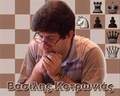 GM Vassilios Kotronias finally returns to the Greek Olympic Chess Team. GM Kotronias was the highest rated Greek player when he argued with the Greek Chess Federation, an argument that lead him to join the Cyprus National Team. Kotronias played first board in the Cyprus Team in every Olympiad and European Team Championship ever since. But now the argument has been solved and the top Greek GM seems ready to return and lead the Greek team to greater achievements. Kotronias was born in 1964 in Athens, and has won the Greek championship 7 (!!) times. He obtained the GM title in 1990 and he is the first ever Greek to pass the 2600 FIDE rating (info by www.skaki.gr and www.chess.gr)
Olympic Heroes: Isaías Pleci
Posted by Webmaster on 30 May 2004
 Born in 1900, he originated from Argentina. Pleci used to say that once he had a chance to play against great chess players he realized how poor his theoretical background was. Perhaps this was not far from reality. Moreover he was never a player with thorough positional outlook which was another serious handicap for him. How come then that the lucky star shone over his head throughout his Olympic career? One has to stress that contrary to the popular image of Pleci as an offensive player - he even earned a nickname "the tank" - the observation of his Olympic games shows it otherwise: he was cautious in the openings and lacking initiative, sometimes showing less technical skills than his partners.
 Where did his strength come from then? From the endgames. The endings and the stage of the game that we used to call the pre-endgame, gave ample compensation for other phases of the game. He had reliable instinct about when and how to simplify the position, and his rivals must often have been surprised when the "frightful attacker" went on for series of trades heading towards seemingly even position where he found tiny yet stable advantages. Sometimes he had a chance to conduct a mortal counterstrike biting from the back ranks the exposed pieces of his enemy.
It might be argued that his enormous successes came from the fact that he used to play at 3rd and 5th board at the Olympiads (the difference between the boards used to be much larger in the past). But there comes an interesting anecdote in this respect. (this is most probably vague story yet still interesting to hear; W.B.) In Warsaw, 1935, Pleci, Argentina's board #3 lost couple of games in the middle of the tournament. Grau, the team captain, decided to put him at board #1 (team Argentina had no reserve players), since in there was no strict board order those days (there was, since 1931! W.B.). The reason was clear: the reserve player was likely to be defeated at top board yet the rest of the team were facing weaker opposition enhancing their chances for earning more points. However Pleci surprisingly started to play much better and defeated a few well-known players. Isaías Pleci is being known as an aggressive, risky, tactical player. We do not think this is correct. The well-known Pleci-Endzelins game (Argentina-Latvia, Buenos Aires 1939 Olympiad), that became famous around the world, is an exception among others. He earned his nickname "Tank" simply because he was the winner, not because he was a master of tactics.
He made his first chess steps at the Círculo de Ajedrez ("Circle of Chess") club in Vélez Sársfield, but most of the time he played for "Jaque Mate" ("Checkmate") Chess Club. He participated in a couple of Argentina Championship's qualifiers until he finally qualified for the main final ("Torneo Mayor") in 1928. He qualified for the final round soon but he lost the match for the title against Grau by 0-4. He took fierce revenge on the next year beating Grau by 4-2 and earning well-deserved title of the Champion of Argentina. As a Champion of Argentina he was invited to take part in the international tournament in Liège (Belgium), 1930. Series of unlucky circumstances - we do not mention his partners' skills here - caused biggest disaster of his international career, as he came last. After having returned to Argentina he defended his title defeating Fenoglio in a final match but then he was beaten twice by Jacobo Bolbochán who made enough effort to get familiar with secrets of positional play. He went back to Europe in 1935 to play for his home country at the Warsaw Olympiad in Poland. He also played in Stockholm, 1937 and at the home soil in 1939, of course. He has superb overall Olympic performance of 41/55 (75%) and he won two medals for his individual performance (bronze in 1937 and gold in 1939). Another memorable achievement of him was the first prize won at the international tournament in Mar del Plata, 1936.
Pleci became frequent visitor at "Círculo de Ajedrez" Chess Club in Villa del Parque once they moved at San Blas St. 3425, just a few minutes from Pleci's house. He obviously enjoyed these visits. He truly enjoyed giving lessons to young and talented chess players, and although some people recognized his attitude a little bit conceited he had gentle and mild personality in fact. One of his club-mates told us about his last visit to the club (this was in 1980). On the following day he had to go to the hospital. He felt that his illness was mortal. He wandered slowly through the club halls, absent in soul, casting hazy glances at all the tables, all the walls, all the pictures. Then he left the club without speaking to anybody...
Here are two of his classical, dazzling wins:
Eliskases - Pleci 0-1, Warsaw 1935 Olympiad
Pleci - Endzelins 1-0, Buenos Aires 1939 Olympiad ("la inmortal Argentina")
/Based on "Nuestro Círculo" bulletin no. 76, translated and revised by Wojciech Bartelski/
Olympic Heroes: Mir Sultan Khan
Posted by Webmaster on 25 Apr 2004
 He was one of most intriguing personalities that have ever appeared at the Olympiads. Originating from today's Pakistan (born in 1905) he went to Europe in 1929 brought by his master, Sir Umar Hayat Khan, and came back to Asia just four years later. He spent rest of his life in his homeland, away of any public chess activities. He received a small patrimony after his master's death which let him farm happily for the rest of his life in Punjab. He died in 1966.
Despite of his exotic looks and suits, with a funny, bulged turban over his head, he was a player of ultimate strength although he used to play Indian version of chess before he came to Europe (thee differences are minor but still important at top level). Whether his master took him to Europe because of his unique chess talent which he was apparently aware of and whether Sultan Khan was a slave of a maharaja or just a servant is not clear. Reuben Fine reported once that he came to a dinner to Sultan Khan master's house and was embarrassed to see the Indian grandmaster serving him the dishes, yet the validity of the story has been questioned many times.
Sultan Khan achieved outstanding successes during his short stay in Europe. He played at top British board at 1930, 1931 and 1933 Olympiads. He never did worse than 50% leading Great Britain to decent top 10 places. He won British Chess Championship three times (1929, 1932, 1933) missing the title only once, in 1931. He beat dr Savielly Tartakower in a friendly match and defeated a. e. Alekhine and Capablanca in a single game. He won shared 3rd place in Hastings 1932/33 behind Flohr and Pirc. His Chessmetrics ratings had been close to 2600 making him world top 20 member at the time and very close to top 10 standards. He is unofficially recognized as first Asian grandmaster.
These are two of his most famous games:
Sultan Khan-Capablanca 1-0, Hastings 1930
Sultan Khan-Flohr 1-0, Prague olm 1931
Olympiad 2008
Posted by Norbert Stull on 19 Apr 2004
Besides Dresden there are 2 other candidates for the organisation of the Olympiad 2008: Tallinn/Estonia and Yerevan/Armenia. The decision shall be taken at the end of October 2004.
P.S. The news about Yerevan sign up has proven false. Thus only Berlin and Tallinn left at the field.
P.S. The news about Yerevan sign up has proven false. Thus only Berlin and Tallinn left at the field.
Chess Olympiad 2008 in Dresden?
Posted by Webmaster on 07 Apr 2004
 Thirty-four years have passed since Germany hosted the Chess Olympiad (Siegen 1970). Now they plan to become the first nation in the history to have held six Olympic events. The bid for year 2008 is Dresden. So far they have no opposition and the deadline for 2008 applications is April 15th, 2004. Below you will find their homepage, the only problem is that they did not translate it from German to English.
http://www.schachbund.de/chess_oly/
Let's complete OlimpBase records!
Posted by Webmaster on 06 Apr 2004
 |  |
 |  |
- For 1976-1994 period - player's titles (GM, IM, FM) and ELOs,
- Haifa 1976 - title corrections,
- Buenos Aires 1978 - team rosters, round-by-round team pairings,
- Lucern 1982, Thessaloniki 1984, Dubai 1986, Thessaloniki 1988, Novi Sad 1990, Manila 1992, Moscow 1994 - team rosters, round-by-round pairings, board-by-board pairings, complete game files.
- ... and miscellanea - articles, photos, reports, extra statistics, trivia and whatever you think maybe of value for thousands of our readers.
Please click the mail icon lying at the menu on the left in order to email us.
Olympic Heroes: Isaac Kashdan
Posted by Webmaster on 28 Mar 2004
 This is our new series devoted to those, who did not earn worldwide credit adequate to their chess skills and Olympic achievements. One of them is certainly Isaac Kashdan (born 1905), relatively unknown US player. In fact he was one of strongest players of the world in early 30's. Even Alekhine mentioned one day that Kashdan might be next World Champion. He earned well-deserved nickname of "the little Capablanca" because of his unique ability to extract victories from seemingly even positions. Unfortunately Kashdan could not engage seriously into chess career. He turned to earn a living as an insurance agent and administrator in order to support his family.
 His Olympic record is ultimate and unique. He participated in 1928, 1930, 1931, 1933 and 1937. He won three gold and one silver medal with US team. He won as much as 52 games overall and lost only 5, one at each Olympiad, two of them in the last round (vs Rubinstein in 1931 and vs Flohr in 1933). He never scored worse than 70% winning two gold individual medals, one silver, one bronze, and one fourth place overall. In Stockholm, 1937 he scored 14/16, the best individual record of all the players. His all-time Olympic record of 79.7% is unique achievement superior to vast majority of chess giants.
He had many serious achievements in non-Olympic tournaments as well. In 1930 he won 1st prizes in Berlin, Stockholm and Gyor. He was 2nd, right behind Capablanca in New York, 1931 and tied for 4th in Bled on the same year. In 1932 he tied 2nd behind Alekhine in Pasadena, tied 1st prize with Alekhine at Mexico City and tied 2nd to Flohr at Hastings. He tied for 1st place in US Championship in 1942 but lost play-off vs Reshevsky.
After the War Kashdan maintained his ties to chess by organizing and directing tournaments, and editing the chess column for the prestigious Los Angeles Times from 1955 until 1982. He was also the co-founder of Chess Review. In 1950 he was awarded the IM title, in 1954 he got the GM title and the IA title in 1960. He passed away at the age of 79 in 1985.
Few have contributed more to the development of the chess life in USA than GM Isaac Kashdan.
This is one of his best and most famous games being a vivid proof for his profound knowledge of the endings. For the above, he was given a special prize for the best ending:
Kashdan - Flohr, Hamburg 1930
Powered by CuteNews