|
Ruslan Ponomariov comments
During September-October 2000, prior to the Olympiad in Istanbul, Ruslan Ponomariov took part all in all four tournaments running. The first one, the FIDE World Cup in China happened to be the least successful for Ruslan. The game against Vasyl Ivanchuk became not just the first official encounter of two leaders of Ukrainian chess but also the decisive line to enter the next stage of the Cup. We may judge on the lessons that Ruslan was able to elicit from his not rightly deserved defeat by his marvellous comments on that game and from the result he achieved in three subsequent tournaments: almost 100% result in Croatia, a great success in the European Club Cup and sharing of the first place in Torshavn - 19 points out of 23 points possible. There may be no doubts that Vasyl and Ruslan will meet again at the board not once but that will never happen at the Chess Olympiad in Istanbul. We wish success to the Ukrainian team and, meanwhile, are going to have a look, this time with the aid of Ruslan Ponomariov, at the first meeting of its leaders that is gradually becoming a history. 26.10.2000.
Ivanchuk,V (2719) - Ponomariov,R (2630)
Shenyang FIDE World Cup (5), 5.9.2000
Annotations: Ruslan Ponomariov
1.e4
Both adversaries badly needed the win as it gave them chances to continue the struggle for the Cup. Hence, the opening selected. Vasyl chooses 1.e4 because he knows that I mostly play Pirc Defense and is, probably, afraid that, after 1.d4, I may choose the calmer Queen's Gambit Accepted instead of the King's Indian Defense (though QGA also does not promise easy life for Black as the lessons of Kasparov-Kramnik match prove).
1...g6 2.d4 Bg7 3.c4
Vasyl still decided to check my knowledge of closed positions which, however, did not subside heat of the battle in this game.
3...d6 4.Nc3 Nf6 5.Nf3 O-O 6.h3
Ivanchuk plays many various systems in the King's Indian Defense but this time he resolved to surprise me with a rare variation that Mikhail Krasenkov successfully advocates lately.
6...e5 7.d5 Nh5 8.Nh2
A rather unusual place for the knight but here it performs protecting functions well, as it will become apparent. Anyway, the main White's idea is to preclude ...f7-f5.
8...Na6
If 8...Qe8, so as to get his way with the advance ...f7-f5, then 9.Be2 Nf4 10.Bf3 f5 11.g3 Nh3 12.Bg2 f4 13.Nf3 g5 14.Rh3 g4 15.Rh1 gf 16.Qf3 Qg6 17.Bh3 fg 18.Qg3 Qg3 19.fg may follow and Black will obtain a slightly worse but hopeless ending, therefore ...f7-f5 is suspended until better time.
9.g3
Now 9.Be2 Nf4 10.Bf3 f5 11.g3 Nh3 12.Bg2 f4 13.Nf3 is not so good as Black might play 13...Ng5 and get just an extra pawn. Earlier, 10...Nc5 was also not bad as it used a weakness of d3 square, that's why White is busy with restricting the adversary's opportunities.
9...Nc5
This is a rather risky move from the positional viewpoint. Black provokes White to play 10. b4 which will strengthen White's play in the queen's side, the other plus is that the a6 knight will be cut off the centre of events. Instead, I hoped to use the advantage in development, besides, White's king, that seemingly does not intend to castle, turned to be a good irritant. As an alternative, it is possible to recommend 9...c6 10.Be2 Nf6 11.h4 Nc5 12.Bf3. Hubner assesses this position in ECO as slightly better for White. It appears to me that after, at least, 12...h5 Black should get a counterplay in the queen's side through ...a5, Bd7 followed by ...cd and b5 as the knight on h2 is positioned not handsomely.
10.b4
White meets the challenge, otherwise I would have trenched the position of my knight by 10...a5. Very bad is 10.Be2 Nf6 11.Bf3 Bh3, and White loses the pawn.
10...Na6 11.Rb1!?N
Despite long explanations of the sense of this position, just this natural move presents a novelty. Earlier, 11.a3 f5 12.Be2 Nf6 13.h4 c6! occurred, Vilela-Bass. Alcobendas 1994, and Black obtained the counterplay disrupting the White's pawn centre. The move in the game simply defends the pawn b4 and, also, takes away a piece from the diagonal a1-h8, which reduces tactical possibilities of Black and, besides, the rook is ready to protect the king, if necessary.
11...f5 12.ef
White follows his principle line and acquire, apart of the already available position pros, the square e4. However, the position becomes still more open which is somewhat hazardous as the king is not castled. Anyway, it appears to be the best way to fight for advantage. With other continuations, Black enjoys a good counterplay. For instance, 12.c5?! dc 13.Ba6 cb =/+ or 12.Bg2 f4 13.g4 f3! 14.Nf3 Nf4 15.Bf1 Qf6.
12...Bf5
The pros of the move 11. Rb1 begin to tell. Now, it is not so good to play 12...e4?! in view of 13.Nb5 e3 14.Be3 Bf5 15.Rb3 +/-, and it is not seen how Black can develop his initiative.
13.Rb3
|
|
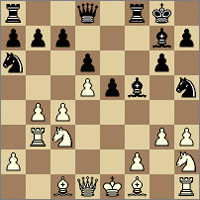
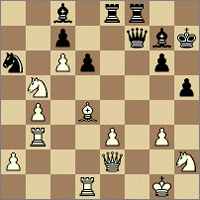
13...Qf6!
This move turned to be rather unexpected for my opponent and he settled down to think having left a bit more than half an hour till the game end (though we played with Fisher control - for each move 30 seconds were added). After 13...Qf6!, Black can figure on the counterplay while after a more natural 13...Nf6 (to defend from 14. g4), White gradually completes development by 14.Bg2 and his positional pros should tell.
14.Be3
White makes the most stout move protecting the pawn f2, but now, with a view of opening up the position, the black knight shifts to f4 with an advantage. However, in case of the other answers Black has still more dangerous play. For instance: 14.g4 Bd3 15.Be3 Bf1 16.Nf1 Nf4 17.Rh2 e4 18.Ne4 Qh4 19.Nfg3 Rae8 with an initiative, or 14.Qd2 e4 15.Nd1 e3 16.Re3 Rae8 (16...Bh6 17.f4 Nf4 18.Bb2 +-) 17.Ng4 Qa1 18.a3 Re4, and all black pieces, except the a6 knight, are rather active.
14...Nf4
|
|
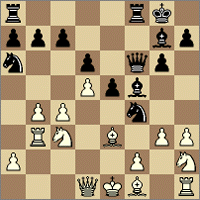
15.Nb5?
Ivanchuk forgets the hanging pawn h3 and finds himself with a bad position at once. Making a joint analysis after the game, we concluded that 15.h4 is stronger, and now we rejected 15...c6!? (unclear), with an idea of opening up the position
(the other moves are, probably, worse. For instance, 1) 15...Rae8 16.Nb5 +/=, and it is hard to find a strengthening plan now. The queen might be stationed on g6 with a threat of Bc2 by 16...h6 (16...g5 17.hg Qg6 18.Qd2) 17.Qd2 g5 18.hg hg 19.Kd1, but now White threatens to grub the knight on f4, and 19...c6 is hardly possible because of 20.dc bc 21.Nd6 Rd8 22.c5 +-; 2) 15...g5 seems more interesting though the idea is about the same, still some time is gained: 16.hg Qg6 17.Kd2 Nd3 18.g4 Nf2 19.Bf2 Bc2 20.Qc2 Rf2 21.Ne2 Qg5 22.Kd1 Raf8 23.Rh3 h6 24.a3, and Black has a certain compensation for the piece though I still prefer the White's position)
because of 16.dc bc 17.c5, and here, as the subsequent computer analysis at home proved, Black still commands resources to support the initiative: 17...dc 18.Ba6 Ng2 19.Ke2 Ne3 (19...Bg4 20.Ng4 Qf3 21.Kd2 Rad8 22.Nd5! Rd5 23.Rd3 Rd3 24.Bd3 Qd5 25.Qb3 +-) 20.fe Rad8 21.Bc4 Kh8 22.Qf1 cb, and the White king founds itself in none too good a plight. Though it is not compulsory to grub 16. dc, but as far as 15...c6 is possible, Black achieves several targets at once: the position becomes more open and the knight a6 stands a chance to enter the play.
Therefore, it seems to me now that the strongest move is that one indicated by Yuriy Drozdovskij: 15.b5!?. It looks like White allow of getting rid from the knight a6 but actually he wants to grub the f4 knight, be left with the material advantage and try to repel the attack. 15...Nc5 16.Bc5 dc 17.gf ef 18.Qd2 Rfe8 19.Kd1 a6. Drozdovskij assessed this position as a compensation for the sacrificed piece. I may add the other approximate variation:
|
|
20.Ng4 Qh4 (20...Bg4 21.hg ab 22.cb +-) 21.Qf4 ab 22.cb Rf8 with a compensation and an idea of 23.Qg3 Bg4 24.Qg4 Qf2 25.d6 Rf4 26.Qe6 Kh8 27.Kc1 Rd4, with an initiative. Black is particularly proud of the bishop on g7.
15...Nh3!
Sure enough! At first, I could not understand why Ivanchuk gives away the pawn as he thought hard before making his move 14. Be3 after which my reply 14...Nf4 was hardly unexpected for him. However, the cold reckoning proved that the piece may and should be grubbed.
16.Qd2
An proof that the move 16. g4 is impossible is given by the variation: 16.g4? Nf2 17.Bf2 Be4 -+, and White sustains material losses.
16...Rae8
Summoning up all strength for the attack on the king and preparing, just for the case, a retreat by the knight back to f4.
17.Be2 h5 18.c5 Bd7 19.Nc3 Nf4 20.c6 Bc8 21.Ba7 Ne2 22.Qe2 e4 23.O-O Qf5?!
Before that moment, both sides played more or les logically: White put up a counterplay on the queen's side and even won a pawn, though, frankly speaking, I did not cling to it in particular; I managed to get an advantage of two bishops and re-animate the bishop on g7. Still, I am not sure that it was worthwhile to spend time for manoeuvring with the another bishop (18...Bd7). But the last move of mine was an evident lapse. Later it became necessary to make another move by the queen losing two tempos all in all. That's why it is clearly better to play 23...Qf7 -/+ at once. I wished, however, to attack the pawn d5 and, besides, protect my own pawn e4 though nobody wanted to grub it. Doing so, I have complicated my task but the advantage is still with Black and the major mistakes are still ahead.
24.Rd1 Kh7 25.Nb5 Qf7 26.Bd4 e3?!
Sacrificing a pawn I intended to make the White king still weaker and to open up the rook e8. However, it was high time to pass over to more specific continuations: 26...bc! 27.Bg7 Kg7 28.dc Be6 29.Rc3 (29.Ra3 Bc4 30.Qb2 Kh7 31.Nd4 Rb8-/+) 29...Rb8 30.a4 (30.a3 Rb5 31.Qb5 Qf2 32.Kh1 e3) 30...Nb4, and now the knight joins the attack, besides, Black has a material advantage. Together, we have looked through the variations after the end of the game, and Yuri Drozdovskij points it out as well.
27.fe bc 28.dc Bh6?
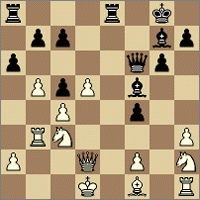
By this moment my opponent had about three minutes and I had approximately six minutes. Still, I clearly remember that I was going to proceed
|
|
28...Be6! (that was the actual idea of the move Qf7) 29.Rf1 Qe7 30.Rf8 Rf8 31.Bg7 Qg7 32.Rb1 Qe5 -/+, and all White's pieces become suspended. Maybe, such position can be held provided a computer is at hand and there is no time limit, however, it is hardly possible over the board and being in time trouble. Nevertheless, literally at the last instant, some stereotypes worked and I felt it miserable to give away the pride of the King's Indian - the bishop g7 - and it cost me very much. White obtained an important tempo for the defense, and now I cannot tell with confidence who stands better.
29.e4!
Switching on the rook to defense. Black has to hurry in order to organise the counterplay because White, as distinct from Black, has achieved a lot on the queen's side.
29...Be6? (time)
This is just a gross oversight. The tension could have been preserved by 29...Nb8!, taking the knight away from the strike: 30.Na7 Bf5 31.Rf3 Qg8 32.e5 de 33.Bc5 Rf6 34.b5 e4 (unclear), and here everything can occur.
30.Nd6!
Vasyl is time handicapped but, unlike me, plays very assuredly and never misses any tactical strikes. I have understood by now that I may hope for a miracle only. Impartial assessment tells that Black's position cannot be saved.
30...cd 31.Rf3 Qe7?!
31...Bf5 32.Qa6 Re4 gave more chances for salvage, now White's task becomes simpler.
32.Qa6 Rf3 33.Nf3 Bg4 34.Qd3?! (time)
34.Rf1 Qe4 35.Re1 +-.
34...d5! 35.e5
35.ed? Qd6!.
35...Rf8??
Probably, my head failed at all. In the course of one game I am making the second blunder. 35...Qb4 36.Nh4 Re6 37.Rb1 Qa5 could have left some chances to survive though Black should lose here. Though the material advantage as well as the initiative stay with White, it is always necessary to resist as much as one can. Sometimes it allows of saving some difficult positions.
36.Bc5 Qf7 37.Bf8 Qf8 38.Rf1 Qb4 39.Nh4 Qe4 40.Qe4 de
Time trouble being over, White easily realize his material advantage:
41.Rf7 Kg8 42.Rf6 Be3 43.Kf1 Bb6 44.e6 e3 45.Rg6 Kf8 46.Rg4 hg 47.Nf5
Black resigned. After the game it became clear that even the win did not give me a chance to enter the quarterfinal because Short overplayed Gurevich. Still, it was a pity to be so near victory and do not go through with it.
© Chess-Sector.odessa.ua
|