|
Toamna Albastra (Blue Autumn): Bucharest, 23rd October - 6th November 2002.
Final Standings: 1. M.Golubev (2528, Ukraine) - 9/13. 2. C.Lupulescu (2480, Romania) - 8,5. 3. N.Djukic (2413, Yugoslavia) - 8. 4-6. D.Vasiesiu (2435, Romania), B.Kalezic (2430, Yugoslavia), B.Badea (2474, Romania) - 7. 7-9. Co.Ionescu (2489, Romania), M.Manolache (2437, Romania), D.Moldovan (2460, Romania) - 6,5... (14 players). Event website: www.geocities.com/rchirila2002/toamnaalbastra.htm; The Week in Chess: www.chesscenter.com/twic/twic418.html#6.
NOTE: The full report and commented games Golubev-Lupulescu, Djukic-Golubev were published in Chess Today, Issue 733.
Mikhail Golubev - Dusan Radovanovic
Toamna Albastra Bucharest (5), 27.10.2002
Sicilian B53
Notes by Mikhail Golubev
Despite the fact that this game ended peacefully after not too many moves played, it was this encounter that I liked more than all my other games from the Toamna Albastra tournament. The opening line was unusual for me and there was a lot of tactical fighting - a good possibility to learn something new. At the critical point in the game a complex situation arose, when the price of each move was very high. The analysis that I am able to provide now is of course incomplete. Perhaps our respected readers will find some new ideas?
1.e4 c5 2.Nf3 Nc6 3.Bb5 d6 4.d4 cxd4 5.Qxd4
Both sides try to out surprise the other in the opening. Finally, we reached a variant that usually arises via 1.e4 c5 2.Nf3 d6 3.d4 cxd4 4.Qxd4 Nc6 5.Bb5.
5...Bd7 6.Bxc6 Bxc6 7.Nc3 Nf6 8.Bg5 e6 9.0-0-0 Be7
|
|
|
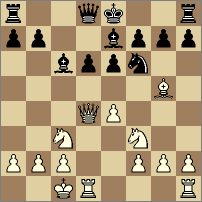
The critical position for system which was used with White by such interesting players as Lutikov, Yukhtman, Vasiukov.
10.Kb1
Two other moves are much more popular.
One of them is 10.Qd3 Qa5! (preventing 11.Nd4!), and then:
A) In my own practice there once occurred 11.Kb1 Rc8 (11...0-0 is the usual move) 12.h4 d5 (possibly, over-optimistic), and in Egiazarian-Golubev, Kiev 1997, White should continue 13.e5 Ne4 14.Bxe7 Nxf2 15.Qd2! (not 15.b4?! Qa3! 16.Qe3 Nxd1 17.Rxd1 Ba4! 18.Bc5 b6) 15...Nxd1 16.Rxd1 Kxe7 17.Nxd5! Qxd5 18.Qb4 Ke8 19.Rxd5 Bxd5, and Black's survival is not quite guaranteed.
B) 11.Bd2 Qc7 12.Nd4 a6 13.f4 b5!?, unclear occurred in Kasimdzhanov-Topalov, Wijk aan Zee 1999.
C) 11.h4 h6 12.Bd2 (12.Bf4 d5!) 12...Qa6 is considered to be fully acceptable for Black.
The main line is 10.Rhe1 0-0, and now:
A) 11.Kb1 h6 12.Bh4 Re8 13.Bg3 (13.Qd3!?) 13...d5 14.e5 Ne4 15.Nxe4 dxe4 16.Qxd8 Rexd8 17.Nd4 Be8! was Svidler-Kasparov, Linares 1999.
B) 11.Qd2 h6 12.Bf4 e5 recently occurred in Black games of Tiviakov, Topalov and other strong grandmasters.
10...0-0 11.h4
|
|
|
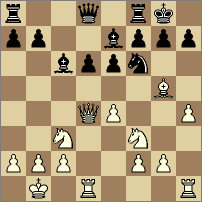
As I found after the game, this position occured only a few times in practice up till now.
11...Qc8
My idea was related with 11...h6 12.Qd3!?, and also with 11...b5 12.Bxf6!, and Black is forced to follow 12...gxf6 (12...Bxf6?! 13.Qxd6 Qxd6 14.Rxd6 Bxc3 15.Rxc6). 11...Qc7 can be played, but it doesn't prepare 12...b5 since White will have 13.Bxf6! (this explains the move, played by Radovanovic - after 11...Qc8, he can follow with 12...b5). In case of 11...Qa5 I thought that I could try 12.Qd2. 11...Rc8!?, finally, deserves some attention too.
12.Rh3
I wanted to «punish» Black for his unusual 11th move and started to prepare a direct kingside attack. Honestly, I am still not ready to evaluate our moves at this stage.
12...b5 13.Rg3 Kh8
In case of 13...e5 14.Qd3 b4 I probably could choose the greedy 15.Bxf6 Bxf6 16.Qxd6 Qe6 17.Qxb4.
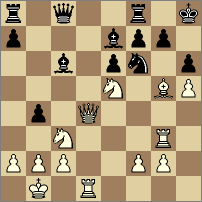
14.e5 dxe5 15.Nxe5 b4! 16.h5!
I didn't seriously consider 16.Bxf6 Bxf6 17.Ne4; after the game I found possible continuation 17...Bxe5 18.Qxe5 f6 19.Qd4 Rd8 20.Nd6 Qc7 21.Qxb4 Bd5 -/+.
16...h6!
|
|
|
Of course, very bad for Black would be 16...bxc3 17.h6 Rd8 (other moves loses at once: 17...Kg8 18.Nxc6 +-; 17...g6 18.Nxc6 +-) 18.Nxf7 Kg8 19.Nxd8 Qxd8 20.Bxf6 Bxf6 21.Qxd8 +/-. After 16...h6! there arises a critical position. Before playing my 14th move I already started to consider it, and finally simply decided that, having so many active pieces White «should have something». Sometimes I over-estimate activity in chess, and maybe this was the case here. Radovanovic played 16...h6, and to my surprize, I was unable to make any of my ideas work for White. After a long reflection, I played a move that I thought would lead to a repetition of moves.
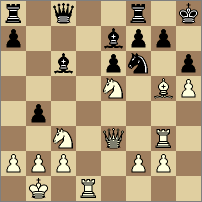
17.Qe3
17.Qf4?! was a critical line, as I thought at some points during the game - and also after it. Then:
A) 17...bxc3? 18.Bxh6 +- loses for Black.
B) I didn't see a good continuation after 17...Kh7, but White can simply follow 18.Bxf6 (instead of 18.Bxh6 gxh6 where I didn't see anything in lines like 19.Rh1 bxc3 20.Rg6 Ng8 21.Nxf7 Bg5 -+) 18...Bxf6 19.Ne4 Bxe5 20.Qxe5 f6, and here I under-estimated 21.Qd4! (21.Qf4 e5! was what I saw). Now Black has problems. If 21...Rd8? 22.Rxg7! Kh8 23.Nd6 Rxd6 24.Qxd6 Kxg7 25.Qe7 +-.
C) However, Black is possibly out of real danger after 17...Nd5!? 18.Nxd5 Bxg5 19.Rxg5 (19.Nxf7 Rxf7 20.Qxf7 Bxd5 21.Rxg5 hxg5 transposes) 19...hxg5, and now:
C1) The nice idea 20.Ng6 fxg6 21.Qh2 finds a nice refutation - 21...Qb8!! -/+, and in all lines Black is able to defend: 22.g3 (22.Qh1 Rf4!; 22.f4 Rxf4! 23.Nxf4 Qxf4 24.g3 Qf6 -+; 22.Qh3 g4 23.Qh1 g5 -+) 22...Rxf2!.
C2) 20.Qxg5 Qd8! -/+.
C3) 20.Nxf7 Rxf7 21.Qxf7 Bxd5 22.h6 gxh6 23.Qf6 (23.Rh1 Qf8 24.Qg6 Qg7 25.Rxh6 Kg8 26.Qh5 Qe5! or 26...Be4 -/+) and maybe Black can play for a win by 23...Kg8!? (23...Kh7 24.Qf7 is draw) 24.Qg6 Kf8.
D) Moreover, the simple 17...Nxh5!, which looks very risky (because it opens the h-file), and was rejected in our post-mortem analysis, possibly wins for Black! At least, I still haven't found any successful continuation of attack for White: 18.Nxf7 (18.Bxh6 Nxf4 19.Bxg7 Kg8 20.Bf6 Ng6 -+; 18.Qh4 Nxg3 19.Bxe7 Nf5; 18.Rh1 Nxf4 19.Bxh6 Ng6!) 18...Kh7 (18...Rxf7!? 19.Qxf7 Nxg3, but not 18...Kg8? 19.Nxh6 Kh7 20.Qh4) 19.Bxh6 Nxg3!? 20.fxg3 Kg8 -+.
Note that 17.Bxh6? gxh6 18.Qf4 Kh7 is the same as 17.Qf4 Kh7 18.Bxh6 gxh6.
|
|
|
17...Ng8!?
Of course, not 17...bxc3? 18.Bxh6 +-.
I expected 17...Kh7, where White hardly has any better than 18.Qd3 Kh8 = (but, of course, not 18...Kg8? 19.Bxh6 Nxh5 20.Bxg7 Nxg7 21.Rh1 f5 22.Rxg7 Kxg7 23.Qg3 Kf6 24.Rh6).
Black is in danger after 17...Ng4 18.Rxg4 Bxg5 19.Rxg5! hxg5 (19...bxc3 20.Rxg7 Kxg7 21.Ng4) 20.Qxg5 f6 21.Ng6 Kg8 (21...Kh7 22.Nxf8) 22.Ne7 Kf7 23.Qc5! with compensation.
And also risky for him would be to play 17...Nd5 18.Nxd5 Bxg5 19.Rxg5 (19.f4!?) 19...Bxd5 20.Rxg7 Kxg7 21.Ng4 f5 (21...f6 22.Qxh6 Kf7 23.Nxf6 with compensation) 22.Qxh6 Kf7 (22...Kg8 23.Qg6 Kh8 24.Nf6 Rxf6 25.Qxf6 with compensation) 23.Ne5 Ke8 24.Qg7! (24.Rxd5 exd5 25.Qg6 Ke7 26.Nc6 Kd7 27.Ne5 Kc7 28.Qc6 =).
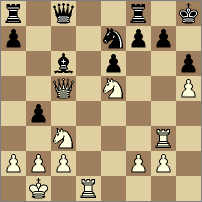
18.Bxe7 Nxe7 19.Qc5!
Fortunately, White had this move that lead to a play with probably balanced chances.
|
|
|
19...bxc3!?
Or 19...Nf5 20.Rgd3! bxc3 (20...Bf3? 21.Qxc8 Raxc8 22.Rxf3 bxc3 23.g4; 20...Bxg2!? 21.Qxb4 is unclear) 21.Nxc6, and in case of 21...cxb2? follows the brutal 22.Rd8! +-.
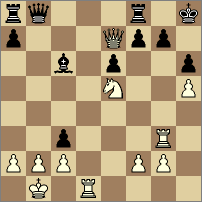
20.Qxe7 Qb8!
|
|
|
21.Rxc3
I disliked 21.Nc4 and, possibly, rightly so. E.g. 21...cxb2!? (other ideas are 21...Bd5!? and 21...Rd8) 22.Nd6 (22.Rd6 Bd5 with idea 23.Ne5 Bxa2 -+) and Black can calmly defend by 22...Kh7! 23.Nxf7 (23.Rd4? Qd8!) 23...Qe8.
After 21.Rxc3 Qxe5 22.Rxc6 arises a position, where Black is a pawn down, but he can win any one of white kingside pawns to restore the status quo. I don't think that White is objectively better, and, having not too many minutes for the next 20 moves I offered a draw, which my opponent decided to accept. 1/2-1/2
© Chess-Sector.odessa.ua
|