|
The best game of Puchko Memorial 2002
Arechchenko,A (2470) - Miroshnichenko,E (2528) [B87]
A.B.Puchko Memorial, Alushta 2002
Annotations: Mikhail Golubev
1.e4 c5 2.Nf3 d6 3.d4 Nf6
Sometimes Black uses this move, instead of conventional 3...cxd4, in order to avoid the variation 3...cxd4 4.Qxd4!?.
4.Nc3
Another specific line would be 4.dxc5!? Nxe4 5.cxd6 Nc6!; and 4.Bb5+!? Nbd7 transposes to 3.Bb5+ system.
4...cxd4 5.Nxd4 a6 6.Bc4
The Fischer-Sozin Attack of course! The young and talanted Ukrainian IM has already played some interesting games in this opening system.
6...e6 7.0-0 b5
One of the most critical Black replies, and undoubtely the most studied one.
8.Bb3 Be7 9.Qf3!
First used by Fischer in 1960, against Olafsson. Other moves leaves White with almost no hope for an opening advantage.
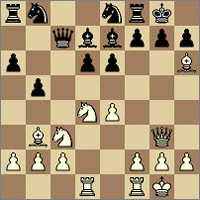
9...Qc7 10.Qg3 0-0 11.Bh6 Ne8 12.Rad1 Bd7
|
|
13.Nf3!?
And this knight retreat was first used by Kasparov against Gelfand in Linares, 1993.
13...Nc6
13...b4 14.Ne2 a5?! 15.Nf4! Kh8 16.Bg5 Nf6 17.Qh4! gave extremely dangerous initiative for White in the above mentioned Kasparov-Gelfand game.
An interesting deviation is the immediate 13...a5!?, which was once used by Kasparov himself as Black (against Short in their 1993 PCA World Championship Match).
14.Bf4! Rd8
14...Qb7!? is an important alternative. Then 15.Rfe1 b4 16.Ne2 (Kasparov-Gelfand, Moscow OL 1994) leads to an interesting and not sufficiently studed play. Alexander Nikitin (the former coach of Kasparov) has published some interesting analysis in the New in Chess Yearbook (2001) where he promised sufficient counterplay for Black after 16...Bf6!? and 16...Na5.
15.e5! dxe5?!
After 15...Bc8 , possible is 16.exd6 Bxd6 17.Bxd6 Rxd6 18.Ne4 +/=.
16.Nxe5 Nxe5N
Also dangerous for Black is 16...Bd6 17.Rxd6 Nxd6 (Istratescu-Wojtkiewicz, Odorhieu Secuiecs Z 1995) 18.Rd1! b4 19.Nxf7!, etc. (Istratescu).
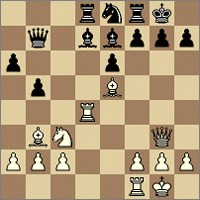
17.Bxe5 Qb7 18.Rd4! +/-
|
|
Quite often in similar positions Black has the possibitly to neutralize White's initiative step by step, but this is probably an exception because White pieces are too active.
18...Bc6
18...Bf6?! 19.Ne4! Bxe5 20.Qxe5 is terrible for Black; 18...Nf6 19.Ne4 looks promising for White, too.
19.Rg4 Kh8
After 19...g6 20.Bxe6! fxe6 21.Rxg6+ Kf7 22.Rh6 Black can hardly survive.
20.Bxe6!?
Up to this point the players have followed the line that I considered in my recently published book The Sicilian Sozin, but here Arechshenko chooses different a way to attack.
I proposed 20.Rxg7 f6 21.Rxh7+ Kxh7 22.Qh3+ Kg7 23.Qg4+ Kh7 24.Qh5+ Kg7 25.Bf4!.
20...Nf6
After 20...fxe6 21.Rxg7 Nf6 22.Qg5, it's not clear how Black can defend against 23.Qh6! without material concessions.
Hardly sufficient is also 20...Bf6 21.Bb3 +/- (but not 21.Bxf6? Nxf6 22.Rxg7 Rg8!).
21.Rxg7! Rg8?!
21...fxe6 transposes to the above mentioned variation with 20...fxe6.
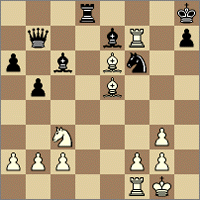
22.Rxf7!!
This is not only a more beautiful, but also a clearer way to win than 22.Rxg8+?! Rxg8 23.Bg4 Bxg2! (or 23...b4 24.Ne2 Bxg2!).
22...Rxg3 23.hxg3!
That simple. There is absolutely no defence for Black.
|