|
Highlights from the match
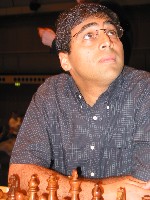
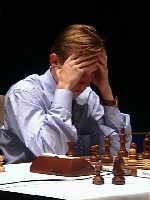
Let's look at some chess from the battle of the two champions.
GAME 1, Aug 16
Ponomariov-Anand (0.5 - 0.5, 39)
|
| |
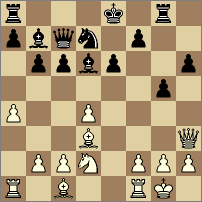
Position after 15.a4
This Caro-Kann position is familiar to Ruslan Ponomariov. It occurred in Ponomariov-Galkin, Lausanne Young Masters 2000. Anand was certainly not well prepared to play this line, since after
15...0-0-0 16.a5 c5 17.axb6 axb6 18.Be4!
White got a huge advantage - which he increased step by step until his unsuccessful 34th move...
18...g4 19.Bxb7+ Qxb7 20.Qc3 Kb8 21.dxc5 Nxc5 22.b4 Ne4 23.Nxe4 Qxe4 24.Qa3 Bc7 25.Be3 Qb7 26.c4 Be5 27.Ra2 Kc8 28.c5 bxc5 29.bxc5 Qc6 30.Qa7 f5 31.Ra6 Qc7 32.Qxc7+ Bxc7 33.c6 Rd5
|
| |
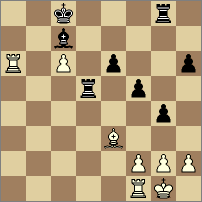
Position after 33...Rd5
34.Rb1?
Ponomariov misses Anand's defence. Instead, he could have won easily by 34.Ra8+ Bb8 35.Rb1 Kc7 36.g3, and then 37.Rb7+.
34...Ra5 35.Rxa5 Bxa5 36.Ra1 Rd8 37.g3 Rd5 38.Bxh6 Kc7 39.Rc1 Bd2 0.5-0.5
GAME 2, Aug 16
Anand-Ponomariov (0.5-0.5, 40)
|
| |
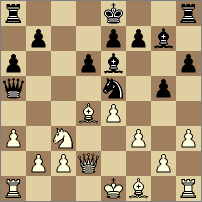
Position after 15.a3
This position from the principled 6.Be3 Ng4 Najdorf line occurred in a few earlier games, including Kasparov-Polgar, Linares 2001 and Bologan-Xu Jun, Bejing 2000.
Ponomariov's new move
15...0-0!?
(Was this prepared together with his coach, GM Bologan?) looks risky for Black, but Anand didn't manage to exploit its drawbacks and after
16.h4 Ng6 17.b4 Qc7 18.hxg5 hxg5 19.Bxg7 Kxg7 20.0-0-0 Rh8 21.Rxh8 Rxh8 22.Kb2 f6
Black had a good position. Later in the game, the opponents played well, and approximate equality resulted, finally, in a repetition of moves.
GAME 3, Aug 16
Ponomariov-Anand (1-0, 44)
|
| |
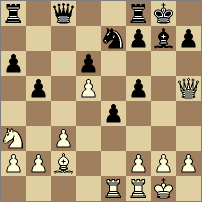
Position after 17...Qc8
Peter Leko twice defended this Sicilian Sveshnikov position (known since 1992) as Black in a recent Dortmund candidate's event: draw against Topalov, and win against Shirov (BTW, on his homepage at Chessgate.de, Leko has already annotated his win in the latter game).
Anand, who was playing the Sveshnikov almost for the first time in his life with Black (but he has played it a lot as White) was probably encouraged by these Leko games, or maybe he wanted Ponomariov to show him how White should play in the Sveshnikov variation ... The game continued
18.Bb3 Ng6 19.Nc2 Re8 20.f4 exf3 21.Rxe8+ Qxe8 22.Qxf3 f4 23.Re1 Qd7 24.Nb4! a5 25.Nc6
And White was clearly better. Step by step Anand lost one, than another pawn, and, in the end, the game.
GAME 4, Aug 17
Anand-Ponomariov (1-0, 38)
|
| |
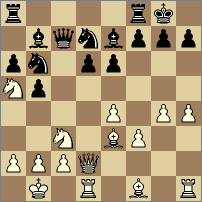
Position after 14...0-0
For the second time in the match Ponomariov played (unusually) the Najdorf variation, which Anand now met with 6.f3, instead of 6.Be3 (so as not to allow the 6...Ng4 variation).
Probably Ponomariov was surprised with Anand's 11th move (11.Nb3) - one way or another, in this game the Indian successfully used his great experience in fighting the Najdorf.
15.Bg5 f6 16.Be3
Anand is ready to spend two tempi, provoking the ...f6 advance that weakens Black's position.
After
16...Ne5 17.Qf2 Nbc4 18.Nxb7 Qxb7 19.Bd4 Rac8 20.Ne2 Nc6 21.Be3 Nxe3 22.Qxe3
White was much better (thanks to Black's weakened e6 pawn). Ponomariov tried to play actively, but following
22...Qa7 23.Qb3 d5 24.exd5 Na5 25.Qd3 Nc4 26.Nf4!
The fate of the game was decided.
GAME 5, Aug 17
Ponomariov-Anand (0.5 - 0.5, 40)
|
| |
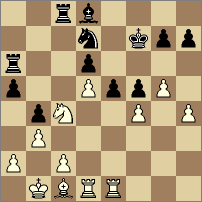
Position after 24.Bc1
One more 'Najdorf' in the match, but this time Ponomariov is White, and a 6.Be3 e5 variation occurred. Ponomariov deviated from Shirov-Svidler 1999 game by 18.Kb1 and 19.f4 (Shirov proposed immediate 18.f4 +/=), and developed some unpleasant pressure.
24...Nxc4!
Not only in the style of the 9th World Champion T.Petrosian, but in Anand's style too - the Indian grandmaster is a big specialist in exchange sacrifices. Black is trying (successfully) to create some kind of fortress. The explanation of Anand's idea lies in fact that after 24...e4? White could continue 25.Ne3! (f5 pawn is attacked) 25...g6 26.h5, opening a lines on the kingside - but now it will be impossible.
25.bxc4 e4
After h5 Black will play ... Kf8, and is able to keep the kingside closed (g6/...h6 or h6/...g6). Nevertheless, White should have chances to make progress on the queenside, but Ponomariov didn't manage to do this and the game quite quickly ended in a draw.
GAME 6, Aug 17
Anand-Ponomariov (0.5 - 0.5, 35)
|
| |
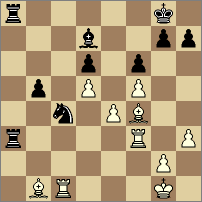
Position after 33...Rea8
In a Ruy Lopez, Ponomariov played, as Black, a line in which he (quite undeservingly) lost a game with White against Beliavsky in the Moscow 2002 FIDE Grand Prix. Anand introduced an interesting novelty and had a position that looked promising, but didn't find a way to make use of his two bishops advantage. Now Black is slightly better. White decides to force matters.
34.Bd3 Ne5
Otherwise Bxc4 and Bxd6 - but now White must exchange his 'good' bishop, and the 'bad one' will remain on the board.
35.Bxe5
And now after
35...dxe5 36.Bf1
A draw was agreed. Possibly, at this point Ponomariov finally lost his psychological initiative in the match: he could play for a win, and maybe it was better to take on e5 with the f-pawn on the 35th move.
GAME 7, Aug 18
Ponomariov-Anand (0.5 - 0.5, 81)
|
| |
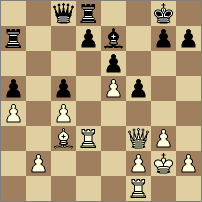
Position after 24...Rd8
This time Anand used quite a popular Paulsen line, which occurred in Kasparov-Anand, Linares 2002. Ponomariov deviated from that duel by 16.g3 and easily got slightly the better chances, thanks to the pressure on the d-file. The 7th game became the longest in the match: Ponomariov tried to exploit his small advantage till move 81, the game ended in the pawn ending with White's pawns on a4, b3, c4, e5 and Black's on a5, c5 and d7. Draw, because White can't make any use of his extra pawn.
GAME 8, Aug 18
Anand-Ponomariov (1-0, 46)
|
| |
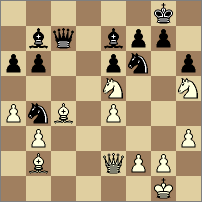
Position after 24...Nb4
For the first time in the match, Anand played 1.d4. In the symmetrical Queens Gambit Accepted structure White had a slightly more active position and Ponomariov's 23rd move allowed Anand to start an interesting and nice attack with a double knight sacrifice:
25.Nxf7 Kxf7
This is forced.
26.Nxg7!
Now Black's king will be in danger in all variations.
26...Bc8
Probably Ponomariov could take a second knight, but how is difficult to be sure in variations like 26...Kxg7 27.Qg4+ Kh8 (another sample line is 27...Kh7 28.Qxe6 Qd8 29.e5 Bd5 30.Qf5+ Kg7 31.exf6+ Bxf6 32.Qg4+ Kh8 33.Qh4 Kg7 =) 28.Qg6 (objectively better is 28.Qh5! Kg7 29.Qg4+ = with repetition of moves), and now Black defends by 28...e5! 29.Qxh6+ Nh7 30.Qe6 Qd8! 31.Bxe5+ Bf6! 32.Bc7 Qc8.
27.Nf5
White has compensation for a knight: two pawns, piece activity and the weak position of his opponent's king.
27...b5?
Perhaps, missing White's 31st move. Instead, 27...Qf4! deserved attention - with interesting, double-edged play.
28.axb5 axb5 29.Nxe7 Kxe7
29...Qxe7 30.Bxb5 also favours White. A better chance to save the game possibly was 29...bxc4!.
30.Bxb5 Qc2 31.Ba3! Qc3 32.Qc4! Qa1+ 33.Kh2 Qxa3 34.Qxc8 Qa5 35.Qc5+ Kd8 36.Qd6+
And White was winning - after another 10 moves the game and the match was over.
Ponomariov-Anand: Web Watch
Official match site: www.chesstigers.de
Coverage at ChessGate.de: www.chessgate.de/turniere/2002/Mainz/index.html
Coverage at ChessBase com: www.chessbase.com
Intensive coverage in Russian at Worldchessrating.ru: www.worldchessrating.ru
Anand's web site: www.tnqsponsorship.com/vishwa.html
Ponomariov's web site: chess-sector.odessa.ua/ruslan.html
Photos: thanks to Axel Fritz and Hartmut Metz at www.chesstigers.de
This article was edited by Graham Brown and published for the first time in Chess Today, Issue 650 (19th August 2002).
|
|


|