Ukrainian Chess Online / Chess-Sector.odessa.ua The First Daily Chess Newspaper on the Net


Eternal Combat Passion

 
Mikhail Vasilyev

Mikhail Vasilyev, FIDE Master


...Chess lovers used to meet at nights at Pyotr E. Geller. He has learned plenty from Boris Verlinsky, the first Odessite to win the country's championship, and quite naturally wished to initiate his three year old son into chess. Extremely popular at that time was the World Champion Jose Raul Capablanca, a Cuban. His popularity still increased after the distribution of the famous V.Pudovkin's film «Chess Fever» that was devoted to the 1925 International Tournament in Moscow. An episode from Capablanca's biography is known when a Jose, a four year old boy, watched his dad playing and managed to win a game with him. Now, some reminiscences of Efim P. Geller himself:
 
«I played at the time by my own rules and all attempts of my father to train me ended with brushing off my enemy's pieces from the board in celebration of the victory. When father and mother left for work, I used to take several sets of chess pieces and arranged cruel fights. The lost pieces were thrown, as a rule, from the fourth floor window into the yard for which I was regularly punished. Still, an existence in a chess media has resulted in my playing with my father and the elder brother in accordance with the rules after I gained some experience in playing with the yard boys».
 
Later the situation developed following the scenario typical for the majority of chess-enraptured Odessa boys. The chess amateur circle functioned in one of the halls of the former Count Vorontsov's palace that was allocated for children. Plenty of tournaments and a gradual ascent by the qualification ladder until one reaches the first category. Chess childhood was interrupted by the war. A youngster graduated from school and became a mechanic at the airport doing the necessary maintenance on fighter planes.
 
As soon as it was possible to come back to a peaceful life, Geller enters the Economic Department of Odessa University. His spare time is devoted to sports, particularly to basketball. It will do him much good in future to preserve his fitness during chess tournaments.
A young Geller featured an irrepressible desire to attack the king taking no account of sacrifices. This aspect is illustrated at best in his game of 1946 against Efim Kogan which opens the collection of Geller's games. The next game in the collection was played against a known Odessa coach Samuil Kotlerman who trained a lot of juvenile chess players of Odessa. Having passed schooling by strong Odessa chess candidates, the young chess player understood a necessity of serious work. Maturity and skill came later. He participates in the Championships of Ukraine and in the semi-finals of the country.
 
The debut in big chess happened in the 1949 USSR Championship. The first in his life game with a grandmaster and the first defeat. Then a loss to the grandmaster Liliental. Here we can feel Geller's combative nature. He gains tempo staying within his play style and comes up to the first place by the last tour, having left behind the leading chess masters. Though the decisive game against a young master Kholmov was lost, Geller shared the third place and won the first GM point which was considered to be a great success for of a young Odessite. Chess history did not know such a sore earlier. From being a master candidate, he jumped to almost being a GM. After the silver medal award of this Championship and the second GM point Geller has to make another attempt. Only following a new major success in the international tournament Geller will be awarded a high title of a GM.
 
He became a country champion in 1955 at the 22nd USSR Championship leaving behind not only a cohort of famous grandmasters but Mikhail Botvinnik himself. This victory was still more honourable as it was achieved after winning the additional match against Smyslov.
The Odessites met his townsman with joy. Meetings with the champion were arranged as well as simultaneous exhibitions. I recollect how my father persuaded a teacher to let me go from lessons and brought me, a 4th year schoolboy, to a simultaneous display that took place in the Steel Wire Rope Plant. where I played with Geller. I still keep a photo of this simul with my father's handwriting on the back: «May 1955, GM Geller's simul». The game ended very soon after it commenced. White knights did their job. There remained a boy at a table holding a chess board with neatly packed chess pieces inside.
 
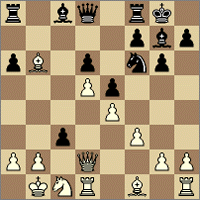
A history of our second meeting is quite unusual. In August 1964 E.Geller was one of the strongest grand masters in the world and he happened to play a simultaneous display in a chess club. After the debut moves 1.d4 Nf6 2.c4 g6 3.Nc3 Bg7 4.e4 d6 5.f3 0-0 6.Be3 e5 7.d5 c6 8.Qd2 cd 9.cd a6 10.0-0-0 Nbd7 11.Nge2 b5 12.Kb1 Nb6 13.Nc1 b4, the grandmaster played 14.B:b6 with a view of getting advantage on the queen side (14...Q:b6 15.Na4). However, there followed 14...bc (diagram).
On coming up next time to the board the grandmaster gauged that after 15.Qf2 Qd7 16.bc Rb8 Black gets counter chances.

diagram

Geller played 15.Qe3 in order to grab the pawn on c3 with the queen after the Black queen retreats. There followed a spectacular sacrifice: 15...Rb8!! 16.B:d8 R:b2+ 17.Ka1 c2!! 18.K:b2 cdN+ 19.Kb1 N:e3. The Black knight that perished on b6 rose like a phoenix in the other part of the board and brought the victory. The peculiarity is that the queen sacrifice idea belongs... to Geller himself.
 
When analysing the games of the Ukrainian Championship, he discovered this beautiful combination - it might have happened in the game of an Odessa master Roman Pelts, however he missed this opportunity in the course of the play. Having returned from the tournament, Pelts shown the Geller's finding to his pupils. During the simultaneous display, being pressed for time, the grandmaster has just forgotten about his wonderful idea. Interestingly, that years later Igor Platonov, a Kiev grandmaster, has shown me an issue of Shakmatny Bulletin containing the games of the Ukrainian Championship where two Odessa chess players Semyon Palatnik and Nikolay Legky took part. There happened no queen sacrifice - responding to grabbing the knight by the bishop, Black grabbed on b6 with the queen (which is the best move), and, eventually, the game ended in a draw. The analysis proves that after 14...bc 15.Qf2! the advantage still stays with White...
 
Geller's chess creed was research. He told: «I refer myself to those chess players who consider that the homework for the game is not limited with the opening only but extends far beyond». I was lucky to feel human and trainer's charm of Efim Petrovich. The master Efim Efimovich Kogan, the honourable coach of the USSR, was a man of extraordinary energy and humour. Quite often Efim Geller drove to visit us in his white «Volga» car. These were rather short, funny and friendly meetings of two genuine Odessites. «Ah, you old dodger!» - exclaims Kogan making his next move. Geller is quick on the draw responding with his move. He was pleased to play with us, youngsters, as well.

Odessa 1978

Later, Efim Petrovich Geller moved to Moscow but he never forgot his home city. For almost four decades Efim Geller (born on 8 March 1925) was among the leading world chess players. Few people approached the chess Olympus so closely as he who participated in the country chess championships 23 times. Geller played successfully in 7 Interzonal tournaments, 6 times was among the contenders for the chess throne and won 7 World Olympiads and 6 European championships. After a quarter of the century Geller managed to set up an unusual record, the record of stable play of the highest class - he won the USSR champion title for the second time. The grandmaster tells: «I like chess logic most of all, I enjoy the chance to analyse and create».
Geller's chess works feature innovative approaches in openings, profound knowledge in the middle game, inventiveness in attack and fine understanding of the ending. An eternal passion for combat is his most significant quality. «Plays aggressively, as a rule, prefers rather to attack than to defend» - that was Mikhail Tal's assessment of his play. Geller is the author of a number of openings systems, books and monographs. Mikhail Botvinnik, the 6th world champion, believed the chess player's strength is determined by four factors: talent, character, health nad preparation. He referred Geller to the masters of great talent who artfully applied his own technique of preparation.
 
«Before Geller came we did not, actually, understood the King's Indian» - state Botvinnik. Why Geller did not become a world champion? Botvinnik asks and answers this question himself: «Probably, to become a world champion, it is useful to be a little of a Puritan. Geller was not the one». Still, Efim Petrovich became a world champion. It was the traditional annual world championship among seniors.
 
 
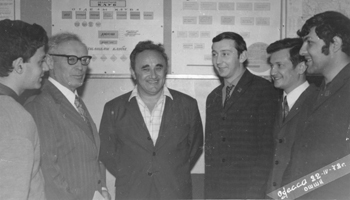
See in A.Averbukh's photo:
Valery Beim, Mikhail Botvinnik, Efim Geller, Semyon Palatnik, Mikhail Vasilyev and Vladimir Klubis. Odessa, 22.4.1978.


© Chess-Sector.odessa.ua

 
[ Home][ Ponomariov][ Ukraine][ UkrBase][ Games][ Chess Today]
[ What's new][ Links][ About us][ Russian][ Search][ E-mail]
Chess Today - The First Daily Chess Newspaper on the Net WorldWinner
 
Chess Ukraine