|
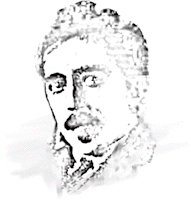
Almost any player is able to find an impressive set of Bohatirchuk's games in various databases, so, I have attached below the only game, Bohatirchuk-Botvinnik, Moscow 1935 - this game was included with his own brief annotations in an article entitled Fedor Bohatirchuk: The Forgotten Champion by E.Sztein and L.Cavallaro, Chess Life, January 1984, pp. 22-23, several months before Bohatirchuk's death. Bohatirchuk has mentioned in his autobiographic book (printed in Russian in San Francisco in 1978) that just after this game a head of Soviet chess organisation, well-known Minister of Justice Krylenko, approached him and said, «You will never beat Botvinnik again!» Indeed Bohatirchuk never had another chance to play Botvinnik. In particular he was not invited to the Moscow International the following year. He had some problems in his native Kiev in 1937 also because some young (let us forgive them) gifted chess players, Konstantinopolsky, Pogrebyssky and Polyak published an awful article against Bohatirchuk in a main Ukrainian newspaper Communist of Ukraine. The main point of the article was that [Bohatirchuk] being a head of Ukrainian chess organization, spent too much money building the city chess club, but spent little time «working with youth», etc.). The only response of Bohatirchuk was that he beat them in the 1937 Championship of Ukraine. Still he refused further chess activity, and concentrated on his medical research and habilitation.
I would like to emphasize that Bohatirchuk and Botvinnik were political antipodes because Bohatirchuk hated bolshevism and stalinism. Meanwhile Botvinnik appeared as the first member of Comsomol (Communist Union of Youth of the USSR) among participants of the Soviet Championships in 1927 and was favoured by Krylenko and exploited from 1935 by Soviets as a strong trump in their propaganda. However, Bohatirchuk never hated Botvinnik, he appreciated him as a great chess player. What is also known is that when Kiev was occupied by the German army in September 1941, Bohatirchuk stayed in Kiev and served as a head of the Ukrainian Red Cross (it was a non-official organization because the Soviet Union had not signed the Geneva Convention). There is evidence that they helped the inhabitants to find each other in the disorder caused by the war, tried (usually unsuccessfully) to help imprisoned soldiers, etc. In February, 1942, all the members of this organization were arrested and held for several weeks. In 1942, Bohatirchuk continued with his medical research, in particular, to restrict some epidemia in the occupied territory. When the Soviet army pushed the German army from Kiev, Bohatirchuk, together with his family and with collaborators of the Institute of Experimental Medicine, migrated to Cracow (Poland), where, by the way, he also met his friend Bogoljubow. A bit later he joined the Committee for Freedom of Peoples of Russia, an anti-stalinistic semi-military organization headed by Russian General Vlasov. This organization was formally approved by German Nazis. That is why Bohatirchuk was 'persona non grata #1' in Soviet chess until the escape of Kortchnoi. In fact, Bohatirchuk hated stalinism and nazism equally. He was aware of numerous crimes of both totalitarian regimes in his native Kiev and elsewhere.
Recently I received a letter from FIDE-GM Unzicker with annotations of his game with Bohatirchuk (a draw in the Klaus Junge Memorial, Regensburg 1946. Bohatirchuk won this small tournament) and his brief reminiscences about how the Soviet delegation 'cut' Bohatirchuk during FIDE Olympiad 1954 in Amsterdam. They also suppresed a Canadian application for Bohatirchuk's FIDE-GM title (sacrificing also GM title of his co-Champion Romanovsky). Another reminiscence from Mr. Yeremenko: Again, I do not know if you would like to include the following story. Spassky, who was introduced to Bohatirchuk in 1970 in Canada, was interviewed recently and has told that when he showed a postcard from Bohatirchuk to Botvinnik and said quite naively: 'What a pleasant person is this Bohatirchuk...', Botvinnik responded, «I would hang this man myself in the centre of the city!» No comments, nice indeed?
Curriculum Vitae:
(1892.11.27, Kiev, Ukraine - 1984.09.04, Ottawa, Canada)
Work Career:
Radiologist, Dr.Med. (habilitation 1940, Kiev)
Head of Ukrainian Red Cross (Kiev, 1941/42)
Professor of Ottawa University (X-rays anatomy)
Barclay Medal and Award of the British Society of Radiology (1955)
Honorary Member of the Canadian Society of Radiology (since 1960)
Chess Career:
Multiple Champion of Kiev since 1911 (ahead of Bogoljubow, et al.)
Author of the 1st chess textbook Shahy in Ukrainian (1926)
Participant of 5 USSR Championships:
Tied 3rd places USSR Championships, 3 times (1923-1935)
Tied 1st place USSR Championship 1927 (with Romanovsky)
Wins in USSR Championships (1927, 1933)
Wins in 2nd Moscow International Tournament (1935)
Champion of Ukraine 1937 (2. Pogrebyssky 3. Konstantinopolsky)
1st in Klaus Junge Memorial, Regensburg 1946 (2. Zemgalis, 3. Unzicker)
2nd (1949) and 3rd (1951) in Canadian Championships
FIDE International Master 1954
Represented Canada at FIDE Olympiad (Amsterdam, 1954)
Canadian Correspondence Chess Champion (1963, 1964)
Click to view: K-19 (1963) Crosstable; K-20 (1964) Crosstable
1st board Canada at Correspondence Chess Olympiad (1962-1965)
ICCF International Master 1967
Scored unique +3,-0,=1 against Botvinnik
article was edited by Ralph P. Marconi:
correspondencechess.com/marconi/bohat.htm
|