|
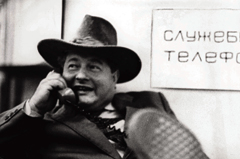
E.Gufeld (2480) - M.Golubev (2495)
Alushta Open (9), 1993 E67
Notes by GM Mikhail Golubev & GM Eduard Gufeld
The games that I have lost have always been one of the primary things that motivated me to work on my chess. I don't remember, but I believe my mother when she says that even at the age of between 7 and 10 I always went to play football after winning chess games, and started to work a lot after my defeats. I am among those that believe it is important to know that you can do a job better in the future with more experience and work, than you do it at present. Otherwise I would inevitably lose interest. So, how can one live at chess without defeats? And how is it possible to improve your play without analysing them? In addition, it seems we can always say that we lose by occasional, illogical blunders etc., but in fact the average quality of the games that we lose are usually higher than average quality of the ones we don't lose, which is one more reason to study them. Some of my defeats were interesting enough to annotate them publicly. My game vs Gufeld below was one that deserved it too, but my notes, prepared in 1993 in «Informant Style» (i.e. without words), remained unpublished until now. Of course I analysed the game without help of any program since I did not have a computer before August 1993. I have not removed any of my old analyses and assessments, but I have added textual comments by Eduard Gufeld (EG) that were courteously sent to me by Gufeld's Editor and Secretary Mr. Frank Berry. I have also added here and there my new, (i.e. done by 27/09/2002), textual comments (MG). Finally, there are a few suggestions taken from Gufeld's Informator notes (Inf 57/554). My apologies for this long introduction!
1.g3 e5 2.Bg2 d6 3.c4 Nf6 4.Nc3 g6 5.Nf3 Bg7 6.0-0 0-0 7.d4 Nbd7
EG: Irony of Fate: the King's Indian is my favorite opening with Black, and now I am playing White against it. But the bishop on g7 - I felt some inner voice saying to me, «This bishop will not be your enemy . . .»
8.Qc2 exd4
EG: Theory offers many alternatives (8...Re8, 8...c6, 8...Qe7) but my young opponent wants to make things clear immediately. Young players, as a rule, don't like protracted positional maneuvering.
9.Nxd4 Nb6
MG: I have always been of the opinion that this operation, introduced by Tal, in the 1950s, allows Black to equailize against 8.Qc2.
10.Rd1
EG: ! White is better developed and ready for immediate tactical fights.
10...Nxc4 11.Ncb5 a6
11...d5 12.b3 c5 (MG: Occurred in older games; but it's risky for Black.)
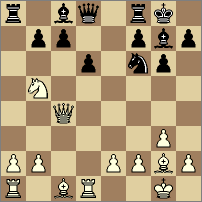
12.Qxc4 axb5 13.Nxb5
|
|
|
MG: I don't think that Black can be worse here - both 13...Bd7 and 13...Ne8 are playable. I was forced to play for a win in the last round, and avoided possible further simplifications.
13...Ne8
EG: So Black has opened the a-file for his rook, the g7-bishop is crowing loudly, and there are no weaknesses in his position. White has more space, however, and as a result, more chances.
13...Bd7 14.Bg5 h6 15.Bf4 d5 (15...g5) 16.Bxd5 (16.Qb3, unclear) 16...c6 17.Bxf7+ Rxf7 18.Nd6 Qe7 19.Qxf7+ Qxf7 20.Nxf7 Kxf7 21.Be5 Be6 (MG: Naturally, there are many other lines.)
14.Qc2!
EG: !! A theoretical novelty (14.Bf4 was usually played here). The idea is understandable: White wants to protect his weak pawns first and to move his queen away from its exposed position; development is to be completed later on. (MG: As I later found out, 14.Qc2! was not really new, but it's a strong move, nevertheless.)
14.Nc3 c6, with counterplay (MG: A few monthes later after this game was played, in the same way, I got good position in my game vs T.Southam.)
14...Bd7?!
EG: {worse is} 14...c6 15.Nxd6 Nxd6 16.Bf4 +/- (MG: Possibly, a good example of Gufeld's intuiton!).
14...Bf5 15.e4 Bg4 16.Rd3 (MG: This occurred in Jongsma-Kozma 1958 game!) (16.f3!?);
14...Qe7!? 15.Bf4 g5 16.Be3 (16.Nxc7 Qxc7, the only move) 16...c6, with counterplay;
14...c6!? 15.Nxd6 Nxd6 16.Bf4 Qf6 17.Bxd6 Rd8 a) 18.Qc5 Qxb2!? (18...Be6 19.b3) 19.Be5 Rxd1+ 20.Rxd1 Bxe5 21.Rd8+ Kg7 22.Qf8+ Kf6 23.Qh8+ (23.Rd6+ Be6!) 23...Ke7 =; b) 18.Ba3 Be6!; c) 18.Bc7 Rxd1+ 19.Rxd1 Bf5! (19...Bg4?! 20.f3!) 20.e4 Bg4 21.Rd2 Rxa2!; d) 18.Bf4 Rxd1+ 19.Rxd1 Bf5 20.e4 Bg4 21.f3 g5! 22.e5 Qf5 23.Qxf5 Bxf5 24.Bxg5 Bxe5; e) 18.Bb4 Bf5! 19.Rxd8+ (MG: In my analyses I missed following: 19.e4! Rxd1+ 20.Rxd1 Bg4 21.f3!, and after 21...Bxf3 22.Rd6! Qe5 23.Bxf3 Bf8 24.Qd2 Bxd6 26.Bxd6 Qf6 White preserves winning chances.) 19...Rxd8 20.e4 Qxb2 21.Qxb2 Bxb2 22.Rb1 Be6.
15.Nc3 c6
15...Bf5?!; 15...Bc6 16.e4 +/=.
16.e4!
16.Bf4 d5 17.e4 {unclear} Bg4 (17...d4) 18.exd5!?.
16...b5!?
EG: !? Bravely played, although forced, in a way. If Black is passive, White will complete his development and put the weak d6-pawn under a lasting siege. EG 57/554: 16...f5?! 17.Bf4 Qe7 18.Re1 +/-.
MG: One recent (2001) game saw 16...Bg4!?.
17.b4!
EG: ! An excellent reply. The advance of the dangerous b-pawn is prevented, while White is planning Bc1-b2 followed by doubling rooks along the d-file. In that case Black would have trouble arranging counterplay, so Misha sharpens the position.
17...Bg4
17...c5?! 18.Bb2+/-; 17...f5?! 18.Bb2 with initiative; 17...Be6! 18.Bb2 +/=.
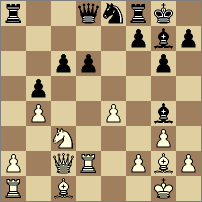
18.Rd2
|
|
|
18...d5!?
MG: Hardly correct, but an interesting idea. It was to some extent prepared by the previous strategically risky moves.
19.exd5
EG: Tempting was 19.h3 Be6 20.Bb2 Nc7 with a slight advantage, but I decided to meet the challenge head-on, hoping for more.
19.h3?! Be6 {unclear} 20.Bb2 Nd6.
19...Nd6
EG: ! Courage is always worth respect.
19...Bf5 20.Qb3 Nd6 21.dxc6 Qf6 22.Bb2 Nc4 23.Nd5 +/- Nxd2 24.Nxf6+ Bxf6 25.Qe3 Bxb2 26.Rd1 Nc4 (26...Nb1!?) 27.Qc5.
20.dxc6 Qf6 21.Bb2
EG: I didn't like 21.Rb1 with some counter-play for Black after 21...Bf5 22.Ne4 Nxe4 23.Bxe4 Bxe4 24.Qxe4 Rfe8 25.Qc2 Qf3 {with counterplay}.
MG: White can play stronger as analysis shows.
21.Rb1!? Bf5 (21...Nc4+/- 22.Ne4!?; 21...Rae8?! 22.Bb2!) 22.Ne4 a) 22...Qe6!? 23.Re2! (23.f3 Nc4 with counterplay; 23.Rxd6 Qxd6, unclear) 23...Rfe8 24.f3 Nc4!? 25.a4!? (25.g4!?); b) 22...Nxe4 23.Bxe4 Bxe4 24.Qxe4 Rfe8 b1) 25.Qc2 Qf3! 26.Bb2 (26.Qd1!? Qxc6, with compensation) 26...Rxa2! 27.Qc1 Rxb2! (27...Bh6?! 28.c7!) 28.Rdxb2 Bxb2 29.Rxb2 Rd8 30.Rb1 Rc8 =; b2) 25.Qd5! Rad8 (25...Re5 26.Qd6 Re6 27.Qc5!?) 26.Qxb5 (26.Qc5) 26...Re1+ 27.Kg2 Rxd2 28.Bxd2 Rxb1 29.c7 Qe6 30.Qb7 +-.
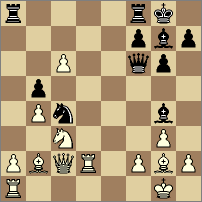
21...Nc4
|
|
|
22.Na4
EG: {the only move} 22.Nd1?? loses to 22...Bxd1.
22...Nxb2!
EG: {worse is} 22...Qf5 or ...Qg5 23.Bxg7 Kxg7 24.Qc3+ Kg8 25.Rd5 +-.
23.Nxb2
MG: Around here we entered into certain mutual time trouble: I had no more that 10 minutes for the next 17 moves. Gufeld put pieces from another chess set at the his right hand side, in order to count moves by removing one piece after each of his moves... Here, or a few moves later somehow he decided that I offered him draw, but I didn't.
23...Bf5
EG 57/554: 23...Rad8 24.Rxd8 Rxd8 25.Rb1.
24.Qb3
EG: 24.Qc5!?.
24.Be4? Qxb2; 24.Qc1?!; 24.Qc5 Qc3.
24...Qc3!
EG: An excellent move: the tension is increasing. In spite of being two pawns down, Black's position seems threatening due to his two powerful bishops. The dark-squared one is particularly strong, having no opponent. And to tell you the truth, a couple of times during the game I was ready to shout: «What are you doing, my friend, are you really against me?»
25.Rad1
25.Qxc3?! Bxc3 26.Re2 Rae8!?.
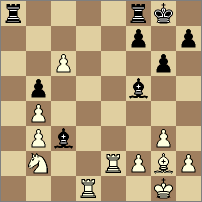
25...Qxb3 26.axb3 Bc3 27.Re2
|
|
|
27...Ra2?? {Time}
EG: Quite logically played: he pins the White rook along the second rank. 27...Bxb4 is bad, as Black would be unable to conquer the passed pawn.; And if 27...Bg4 then 28.f3 Be6 29.Rxe6!? fxe6 30.Nd3 (... Bh3, Nc5 +-) would clearly be favorable to White.
27...Bxb4; 27...Bg4! 28.f3 Be6, with compensation.
MG: Both comments to Black's 27th were subjective, and my one - especially. 27...Bg4!?/28...Be6 was hardly more than a good practical chance.
28.Na4! {the only move} +/-
EG: ! Another jump to the same place, this time winning. The point can be seen in the line 28...Rxe2 29.Nxc3 (Black has gained the exchange but lost his Gufeld Bishop) 29...Rb2 30.Nd5 (or 30.Bd5) and the fate of the game is a secret no more. Now Black must grab the «kamikaze knight» and try to trouble the waters, but the tactics go my way this time.
28...bxa4 {the only move}
28...Rxe2 29.Nxc3 Rb2 30.Bd5.
29.Rxa2 axb3
EG: The passed pawn seems very threatening, but I had seen well before how to pacify it.
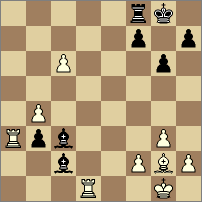
30.Ra3 Bc2
|
|
|
31.Rxb3!? {Time}
EG: ! This is the point. The dangerous pawn is eliminated, but in spite of the opposite-colored bishops (with bishop of the same color, 31...Bxd1 and there is nothing to discuss) the way to victory is not too complicated.
31...Bxb3 32.Rd3 Bxb4 33.Rxb3 Bd6?!
EG: As will be obvious later, 33...Ba5 would be more precise, although White would have won in this case, too. (MG: I missed White's 35th. With the strongest defence Black could put up a lot of resistance.)
33...Ba5! 34.Rb5!? Bc7 35.Rb7 Rc8 36.Bh3 f5 37.Bf1 Bd6 (37...Kf7? 38.Ba6 Kf6 39.Ra7 Bb6 40.Bxc8 Bxa7 41.Bxf5 +-).
34.Rb7 Rc8 35.Rd7!
EG: A precious tempo.
35...Be5 36.f4 Bc7 37.Bd5 +- Bb6+ 38.Kf1 Rc7 39.Bxf7+
EG: Two extra pawns = victory.
39...Kf8 40.Rxc7 Bxc7 41.Bd5 h6 42.h4 g5 43.hxg5 hxg5 44.fxg5 Bxg3
EG: Black has no more weak pawns, but what about White's passed pawns?
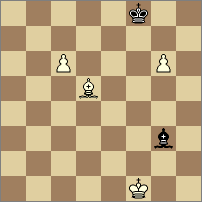
45.g6
|
|
|
EG: The White king goes to the center and wins.
MG: I didn't see any chances and resigned after 10-15 minutes of reflection. Gufeld said «thank you», now I am not sure for what. 1-0
This article was edited by Ralph P. Marconi and published in Chess Today, Issue 690 (28th September 2002).
|