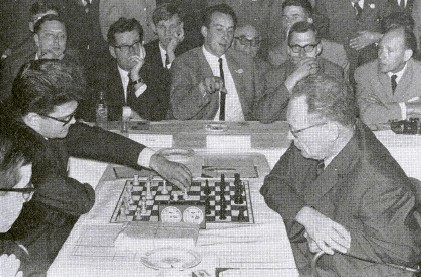
3rd European Team Chess Championship: Hamburg 1965

<< [ Information || The Championship Final || Group 1 | Group 2 | Group 3 || Statistics — final | Statistics — preliminaries ] >>

Information

[ Basic data | Tournament review | Individual medals | Interesting games ]


Basic data

3rd European Team Chess Championship
(see all-time tournament summary)
Dates: Preliminaries: June 1963 - August 1964
Final: 6th - 16th June 1965
City: Hamburg (West Germany)
Location information: Final: Hamburg, West Germany
Venue: Final: Curio-Haus (name after Johann Curio),
contemporary photo
Tournament Director: Mr. Willy Fohl (GER)
Chief Arbiter:
Teams participating: Preliminaries: 10 in three groups
Final: 6
Players participating: Preliminaries: 113 (incl. 11 GMs and 27 IMs)
Final: 71 (incl. 25 GMs and 23 IMs)
Games played: Preliminaries: 210
Final: 300
Competition format: Preliminaries:
Group 1: five board Crepaux system (how it works?)
Group 2: double five board Crepaux system
Group 3: Ten board double round robin.
Group winners and runner-up from group 3 joined Soviet Union and Yugoslavia, top two from 1961 championship who qualified to the Final without play.
Final: Ten board double round robin.
Final order decided by: 1. Game points; 2. Sum of board coefficients
The tie-breaking system was quite rare. Points scored on consecutive boards were multiplied by respective coefficients (58 points for win on board 1, 56 pts for win on board 2 etc.... 42 points for win on board 10; draws counted half of it) and then added up to score 2853 for Yugoslavia and 2846 for Hungary.
Time control: 40 moves in 2 hours 30 minutes, then 16 moves in each next hour
PGN game file: 65etch.pgn
Special thanks to Rainer Smeykal for providing additional info.


Tournament review


The third cycle of the European Championship had been scheduled for 1965. As in 1961, six teams entered a double round robin competition of which two (USSR and Yugoslavia) qualified by default and four won their respective preliminaries. The preliminary stage did not bring major upsets. Hungary and Romania qualified from the Eastern European group at the expense of Bulgaria and East Germany while the Netherlands overcame Spain easily. USSR were as usual major favourites for gold although they were missing Tal, Spassky, Geller, Keres and Polugaevsky. Hungary and Yugoslavia were preparing for a close battle for silver, sending their strongest line-ups to Hamburg.

Schmid-BotvinnikHungary made a huge step towards silver beating Yugoslavia in the very beginning. The Soviets took sweet revenge for the Tel Aviv 1-3 debacle and beat West Germany by 6½-3½. The 8-2 win over Romania in round two let the Soviets leave the opposition far behind and they strengthened their lead by consecutive 6-4 wins over Yugoslavia and Hungary. USSR were in a clear lead after the first cycle with 34 points ahead of Yugoslavia - 29 and Hungary - 28. West Germany were lying fourth ahead of Romania. Day six saw the Hungarians beating Yugoslavia again and both teams leveled on points. In round 8 the Soviets beat Yugoslavia 7-3 and virtually sealed the gold medals. Hungary fought hard to overtake Yugoslavia defeating the Soviets sensationally in the penultimate round thanks to Szabó's magnificent win over Botvinnik and Bilek's win over Korchnoi. With the last round to go Hungary and Yugoslavia were in tied second and they both won last round's matches by 6½-3½. Both teams finished with 57 points then and Yugoslavia were awarded silver medals on the basis of a special tie-break. By many this was considered unfair since the Hungarians had an excellent match point record (nine wins and only one loss) and had won both matches vs Yugoslavia. The controversial tie-breaking method had soon been abolished. Caissa, the goddess of chess, soon settled the score. One year later, at the Havana Olympiad, Hungary and Yugoslavia came in tied third. Hungary were awarded bronze medals on the basis of a verdict by the jury, who decided to use unweighted Berger (not weighted, as many suggested).

The Soviets' lead over the chasing group was impressive (as usual) but Botvinnik's three consecutive losses were the sensation of the event. Never before and never after did Botvinnik lose three games in a row against non-Soviet players. Also, after an excellent first-cycle performance (4½/5) Viktor Korchnoi, the hero of the 1957 and 1961 championships, had a dreadful second cycle performance (1/4). The best percentage results were achieved by bottom board players: Boleslavsky and Lein. Gligorić, who courteously gave the right to play on the top board to Ivkov, produced the best performance of all Yugoslav players. The Hungarians won two individual prizes for best board scores (Barcza and Forintos) and Portisch (their top board) avoided a single loss. West Germany easily took fourth spot despite Unzicker's poor play (=7-3) that was compensated for by Schmid's excellent show. Romania came fifth (only two players achieved 50% results and nobody scored better) and the Netherlands came sixth losing all 10 matches (Donner's 5½/10 was the only consolation).


Individual medals

1st Board
no. name flag code pts gms %
1. GM Petrosian, Tigran Soviet Union URS 6 10 60.0

2nd Board
no. name flag code pts gms %
1. GM Gligoric, Svetozar Yugoslavia YUG 7 10 70.0

3rd Board
no. name flag code pts gms %
1. GM Korchnoi, Viktor Soviet Union URS 5½ 9 61.1

4th Board
no. name flag code pts gms %
1. GM Smyslov, Vassily Soviet Union URS 6 9 66.7

5th Board
no. name flag code pts gms %
1. GM Barcza, Gedeon Hungary HUN 7 10 70.0

6th Board
no. name flag code pts gms %
1. IM Forintos, Győző Hungary HUN 7½ 10 75.0

7th Board
no. name flag code pts gms %
1. GM Taimanov, Mark Soviet Union URS 5 8 62.5

8th Board
no. name flag code pts gms %
1. GM Averbakh, Yury Soviet Union URS 6 8 75.0

9th Board
no. name flag code pts gms %
1. GM Krogius, Nikolai Soviet Union URS 4½ 8 56.3

10th Board
no. name flag code pts gms %
1. GM Boleslavsky, Isaak Soviet Union URS 5 6 83.3

1st Reserve Board
no. name flag code pts gms %
1. Lein, Anatoly Soviet Union URS 6 7 85.7

2nd Reserve Board
no. name flag code pts gms %
1. Lutikov, Anatoly Soviet Union URS 6½ 8 81.3


Interesting games


Gligorić tripled Black's pawns and blocked the kingside play.
Gligorić, Svetozar (YUG) - Botvinnik, Mikhail (URS) 1 - 0

A classic demonstration of Petrosian's positional mastery.
Petrosian, Tigran (URS) - Ivkov, Borislav (YUG) 1 - 0

A lot of pieces were hanging in the course of the game but they were rarely taken.
Bilek, István (HUN) - Korchnoi, Viktor (URS) 1 - 0

A series of exchanges opened the board, yet the black queen was still trapped.
Gligorić, Svetozar (YUG) - Szabó, László (HUN) 1 - 0

23.g4? made f4 available to the black knight.
Botvinnik, Mikhail (URS) - Szabó, László (HUN) 0 - 1

White converted positional pressure into material gains.
Boleslavsky, Isaak (URS) - Hartoch, Robert (NED) 1 - 0

Shortest decisive game (14 moves!).
Kestler, Hans Günther (GER) - Van Geet, Dirk (NED) 1 - 0

Bc8-g4 followed by h7-h5 is a familiar route to a quick win in the Exchange Variation of the Ruy Lopez.
Barendregt, Johan (NED) - Teschner, Rudolf (GER) 0 - 1

Soviet players rarely lose in 20 moves. This is a notable exception.
Forintos, Győző (HUN) - Averbakh, Yury (URS) 1 - 0