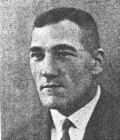
 Teodor Regedziński was born on 28 April 1894 near Łódź. His biography is marked by a tragic conflict of loyalties and by choices that could hardly have satisfied everyone. Although Polish by birth, he was of German descent: his father, a blacksmith by trade, was a German named Reger. Coming from a poor family, he had to start earning a living at an early age. He had lived in Łódź since 1908 and joined the Łódź Association of Devotees of the Game of Chess (Łódzkie Towarzystwo Zwolenników Gry Szachowej), the city's strongest chess club. In 1912 he finished second (behind Salwe; Rubinstein did not play) in an unofficial city championship. During WWI he was temporarily detained by the Austrians but was released in 1916. In 1917 he finished third in the club championship, behind Rubinstein and Salwe. However, in 1918 and 1919 he won it, although Rubinstein was absent. He took part in all four pre-1939 editions of the exceptionally strong Polish Championship. In its inaugural edition, in Warsaw in 1926, he shared third prize with four other players. The following year, in Łódź, he finished fourth, but the field was much stronger; Rubinstein won ahead of Tartakower and Makarczyk. Later that year he won the master tournament in Kecskemét, a result that later served as the basis for the IM title he was awarded decades afterwards.
 In 1928 he was a member of the Polish team at the 2nd Chess Olympiad in The Hague, where he scored 10/13 and received third prize for best individual result (board order was not known in those days); he also won a bronze medal with the team. In 1930 he finished 8th in an international tournament in Štubnianske Teplice (present-day Štubnianske Teplice, Slovakia), defeating, among others, Lilienthal and H. Steiner. In 1933 he went to Folkestone, but physical fitness had always been his Achilles' heel and the dry maritime climate undermined him. He was not selected for the national team at the Warsaw Olympiad in 1935 because he had performed badly in the 3rd Polish Championship earlier that year, finishing 11th. In 1937 he finished 8th in the 4th national championship, which was a huge open tournament; Tartakower won ahead of Ståhlberg of Sweden and Najdorf. At the Stockholm Olympiad he reached the peak of his career, scoring a marvellous 11/13 (+10=2-1) to win second prize for the best result on his board and the third-best overall result. He also contributed greatly to Poland's bronze medal. In August 1939 he left for the Chess Olympiad in Argentina, where the outbreak of WWII found him and his teammates. Unlike the other members of the Polish team (Najdorf, Frydman, Tartakower), who benefited from the hospitality of the Jewish diaspora in Buenos Aires and stayed there for some years, or even permanently, he decided to sail back to Europe, where his wife and son were waiting.
After returning to occupied Poland, he decided to sign the Volksliste, thereby yielding to his German roots and renouncing loyalty to Poland, which many Poles regarded as a capital offence. Under the name Theodore Reger he played in a number of chess tournaments held under Nazi patronage, including the 7th German Championship in Bad Oeynhausen in 1940, where he finished 10th. In 1941 he played in the Generalgouvernement Championship in Cracow, won by Alekhine. The Generalgouvernement comprised part of the territory of pre-war Poland and enjoyed only a semblance of autonomy, while remaining under strict Nazi control. Because of his linguistic skills (he spoke Polish, German, Russian, English and French), he was appointed by the German Army as an interpreter.
After the war he returned to Łódź (it remains a mystery to me why he chose to leave Germany and face the new Polish reality) and was arrested by the newly installed communist authorities. He was sentenced to four years in a labour camp for collaboration with the fascist regime. The years he spent in prison broke both his health and his life. In the late 1940s he resumed playing, although he devoted most of his chess-related activity to work as an organiser and activist. In 1952 he even managed to win the championship of Łódź once again and finished 5th in the national championship. His deteriorating health, however, made this his swansong. He died in 1954.
His chess career was not dazzling, although his Olympiad record certainly was. He played 46 games overall, winning 26 and losing 6 (71.7%). He won three individual and three team medals. He was also a member of the Polish team that took silver at the unofficial Olympiad in Munich.
His contemporaries recalled him as a humble, passionate man and a true chess addict. He did a great deal for the development of youth chess in his hometown. His playing style was described as positional and tenacious in defence. He was well known for his broad theoretical knowledge.
See Teodor Regedziński's all-time Olympic record.
Teodor Regedziński's record from szachypolskie.pl [PL].
See one of his games from the 1937 Olympiad:
Teodor Regedziński (POL)-Jiří Pelikán (CSR) 1—0