Libia Satranç Olimpiyadi (review in Turkish; many games not retyped)
| "The Against Chess Olympiad": Tripoli 1976 |
| "The Against Chess Olympiad" | |
| Date: | 24th October - 15th November 1976 |
| City: | Tripoli, Libya |
| Venue: | Beach Hotel |
| Organizer: | Col. Muammar al-Qaddafi |
| Teams participating: | 38 (including 4 "observers") |
| Game system: | 13 round Swiss |
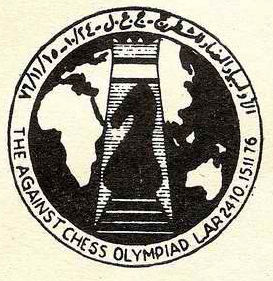
| Official logo: | |
| Downloadable game file: | 76olymp.zip (72 games) Libia Satranç Olimpiyadi (review in Turkish; many games not retyped) |
|
See also the Haifa Olympiad. |
| no. | team | code | flag | ∑ | players |
| 1. | El Salvador | ESA |  |
38½ | A. Grimaldi, R.Grimaldi, Infante, Camacho, Pineda, Velásquez |
| 2. | Tunisia | TUN |  |
36 | IM Bouaziz, IM Belkadi, Drira, Sbia |
| 3. | Pakistan | PAK |  |
34½ | IM Farooqi, Ali, Ahmad, Mirza, Mohiuddin, Mazhar Hussain |
| 4. | Iraq | IRQ |  |
33½ | |
| =5. | Italy | ITA |  |
32½ | Magrini, Trabattoni, Corgnati, Giordano, Mazzamuto |
| =5. | Turkey | TUR |  |
32½ | IM Onat, Öney, İpek, Atakişi, Gümrükçüoğlu |
| 7. | Afghanistan | AFG |  |
29½ | Ada, Obaidi, Hamidullah, Sharif |
| =8. | Nicaragua | NCA |  |
27½ | Pilarte, Rosales, Montalvan |
| =8. | Panama | PAN |  |
27½ | Haskins |
| =10. | Bangladesh | BAN |  |
27 | Kampoarai, Shuda Ahmed |
| =10. | Sri Lanka | SRI |  |
27 | Parakrama |
| =10. | Portugal | POR |  |
27 | Santos, Bastos |
| =13. | Algeria | ALG |  |
26½ | Baghli, Henni, Rakem, Belghanem |
| =13. | Morocco | MAR |  |
26½ | Bakali, Kaderi, Najjar, Iraqui, Abbou |
| =13. | The Philippines | PHI |  |
26½ | |
| =16. | Kenya | KEN |  |
26 | Saif Kanani, Ramesh Sharma, Willie Sekano, Nazir Lone, Aslam Adam, Abdul Tejpar, Aslam Adam |
| =16. | Uruguay | URU |  |
26 | Maiztegui, Toson, Gilardoni, Pérez |
| =16. | South Yemen | SYE |  |
26 | |
| =19. | Trinidad & Tobago | TRI |  |
25½ | Lee, Sears, Payne, Morris |
| =19. | Malta | MLT |  |
25½ | Camilleri, Gouder, Psaila, Busuttil |
| =19. | North Yemen | NYE |  |
25½ | |
| =19. | Madagascar | MAD |  |
25½ | |
| 23. | Lebanon | LIB |  |
25 | Kouatly, Sursock |
| =24. | Libya | LBA |  |
24½ | |
| =24. | Jordan | JOR |  |
24½ | |
| =24. | Uganda | UGA |  |
24½ | |
| =24. | Kuwait | KUW |  |
24½ | |
| 28. | United Arab Emirates | UAE |  |
20½ | |
| 29. | Mauritius | MRI |  |
20 | |
| 30. | Palestine | PLE |  |
18½ | |
| =31. | The Gambia | GAM |  |
18 | Newman |
| =31. | Oman | OMA |  |
18 | |
| 33. | Mauritania | MAU |  |
17½ | Honghin |
| 34. | Somalia | SOM |  |
7 |
|
Politics rears its ugly head only too often in international competition and chess has never been exempt. In 1976 the Soviet Government would not allow its country's chess teams to play in Israel and this boycott naturally extended to all the satellite countries. Worse still than the actual boycott was the attempt by Libya to organize a rival event, dubbed the "Against Israel Olympiad" in most of the pre-tournament publicity but called the "Against Chess Olympiad" on the emblem which appears in the programme of the Libyan tournament. None of the world's strong chess countries sent a team to Tripoli. The Arabs-proper attended a "counter Olympiad" held at exactly the same time as the official FIDE Olympiad in Haifa. But the Arabs were certainly not missed as far as chess ability is concerned! The Tripoli "Olympiad" attracted 38 teams (no communists though, but there were gossips USSR might take part) including some FIDE members, like Portugal, Italy (who were in fact represented by the Palermo Chess Club), Malta, Turkey or the Philippines. The Philippines, Italy and Uruguay were the only nations to have appeared both in Haifa and Tripoli. The Uruguayan team was made up of political dissidents, who happened to be competent chess players, and were escaping from the military dictatorship in their home country. Their first board, Lincoln Maiztegui Casas became one of Uruguay's leading journalists many years later. In order to attract as many nations and players as possible to Libya Colonel Gathafi offered full fares and accommodation to all the teams and captains. Each team had its own car and driver and each team member received $8 a day. It is understandable then that certain smaller developing countries sent their people to Tripoli, but looking at the list of competing players the standard of games was obviously very low (no GMs and just a few IMs). FIDE authorities decided to appoint a commission to investigate the event, with special attention to the future FIDE status of the entries there. El Salvador were definitely not among the favourites and they were quite surprised to find themselves at the top of the table. The Salvadori led by 17-year-old Boris Pineda took early lead after 4-0 vs Dutch Antilles and 3½-½ vs Morocco and hold the gold medal positions until the end despite of two 1½-2½ defeats. Tunisia with IM Bouaziz at top board easily took second place, perhaps a little bit disappointing for them yet they beat the champions in a direct clash. Pakistan lead by IM Farooqi fought hard to take the bronze. The host nation were awfully disappointed to lie down in 24th place. Uruguay might have done much better hadn't they only lost three matches (12 games) by default due to being late. * * * Because of the political situation, it was feared that selecting Israel for the 1976 Chess Olympiad would create difficulties. In the end, these concerns materialized and two chess Olympiads were held at the same time: Haifa (24 October – 11 November 1976) and Tripoli (24 October – 15 November 1976). In 1974, due to the increasing costs of the Olympiad, only two countries put forward bids for the next Olympiad. Sweden’s proposal—that it would cover the expenses of each team—was not accepted. The General Assembly rejected Israel on the grounds of insufficient security and because the Olympiad had already been held there in 1964. At the extraordinary congress held in Bergen in March 1975, Iran’s candidacy was deemed appropriate. However, in May, FIDE President Max Euwe announced that Iran had withdrawn its candidacy and asked the federations to answer two questions within a very short time: Should the FIDE Congress and the Olympiad be held in Israel, or should they be canceled? If the Olympiad were held in Israel, would the federations send their teams? President Euwe, who visited Israel in June 1975, stated that every guarantee had been given for the safety of the players and that the majority of federations supported holding the Olympiad in Israel. Of the 52 countries that responded, 34 were in favor, 16 against, and 2 abstained. In a letter dated March 28, 1976, sent to all FIDE members, the Libyan Chess Federation accused President Euwe of putting member countries in a fait accompli: “The reasons for rejecting Israel’s candidacy have not changed. Since there are 88 member countries, the number of those giving a positive response does not constitute a majority. The very short time allowed prevented many federations from responding, and some received the letter only after the deadline. The President’s questions should also have included whether there was another candidate to organize the Olympiad.” After the candidacy supported by the Arab federations (Algeria) was also rejected, the Libyan Chess Federation, on behalf of 17 Arab countries, decided to organize a “Counter-Olympiad” on the same dates. All countries could participate with 4 players, 2 reserves, a team captain, and a federation president. The tournament was later renamed the “International Chess Olympiad,” and women’s teams—consisting of three players and a team captain—were also invited to participate. At the Olympiad in Tripoli, representatives of the participating federations made decisions on two main issues: sending a letter of no confidence and condemnation to President Euwe and the FIDE Bureau, and calling for an extraordinary FIDE Congress as soon as possible. Undoubtedly, the main question for the future of FIDE is how far politics and chess can be intertwined. The withdrawal of some Eastern European players from the Barcelona zonal tournament due to political judgments, whether the Soviet grandmaster Korchnoi—who sought asylum in the Netherlands—would be able to participate in candidates matches, and the readmission of South Africa to FIDE despite its suspension due to racial discrimination are among the political–chess relations of the past and coming year. “Gens Una Sumus” (We Are One Family). Within the meaning expressed by these words—the motto of FIDE—chess players around the world will find a solution to the problem that is eroding and dividing FIDE. Despite some shortcomings in organizing the International Chess Olympiad, it was generally successful. The players’ travel expenses were covered. The Beach Hotel on the coast was entirely for the players. Transport to the city was provided by small buses, and each delegation was assigned a guide. Countries that were not FIDE members also participated in the tournament. Libyan Revolutionary Command Council Chairman Muammar Gaddafi welcomed the players, and several ministers showed great interest in the Olympiad by attending the playing hall and organizing banquets. The opening of the congress and the distribution of prizes were carried out by Revolutionary Command Council member and Minister of the Interior, Major Khoweldi El Hamidi. The International Chess Olympiad showed that chess was spreading rapidly among countries that were not yet members of FIDE. The successes of Afghanistan, Bangladesh, and Sri Lanka—countries that were not FIDE members and had not participated in previous Olympiads—attracted attention. As in chess, these countries, which are also in the process of economic development, have in many cases placed chess under state patronage as a sport. This should serve as an example for us, who entered the path of development before them. / written Ümit Ünkan, Vice President, Turkish Chess Federation / |