Bora Kostic was born on 24 February 1887 in Vrsac. His first chess steps he
started when he was ten, and as early as he was in grammar school he was one
of the best chess-players in Vrsac. His biggest competitor from the grammar
school days was five years older, Sava Gerdec, who taught him the chess theory.
Their fight for the chess reputation was finished when Kostic went to study
to Budapest. He finished Oriental trade academy there, but without neglecting
chess.
His first great chess result was achieved in Budapest 1909, when he won at
the tournament of the greatest Hungarian chess amateurs. This victory opened
the door of the Vienna chess society to young Kostic, and that was the chess
metropolis of that time.
In 1911 he achieved sensational victory in the match
with the American champion, Frank Marshall. His first real "baptism of fire"
Bora Kostic had that same year at the International grand master tournament
Karsbad (Karlove Vari). In extraordinarily strong competition he won the title
of the international master. Then followed the visit to Nordic countries where
he won over the champions of Danmark and Sweden, as well as the very powerful
Rudolf Spielmann.
In 1913 he moved to the capital of Argentina, Buenos
Aires where he worked as the chess lecturer at the Military academy. He had
been cruising on one Argetine warship across many seas. In Argentina he won
in the matches with all their best players, and also the champion of this
country, Roland Ilja, 6:0.
In 1915 he went to New York and started the chess tour
from the east to the west coast. On that famous six-month-long tour, Bora
Kostic achieved the world record in the number of played games on simultaneous
exhibitions. Out of 3281played games he lost only 112, and made draw in 237.
During his stay in America he visited Nikola Tesla, while he was the chess
teacher to the famous tenor singer Enrico Caruso.Playing numerous games and
tournaments, master tournament of the "Manhattan chess" club being
the most famous in 1918, Bora Kostic was ranked immediately after Capablanca
on the whole American continent. Especially because their four games played
at two tournaments ended draw. That was why their match in 1919 happened,
when the genius Capablanca won with the great result.
In the same year he returned to Europe and in Hastings took
the second place after Capablanca. The next year in Hastings he took the first
place with 100% gained points, which nobody repeated during the long tradition
of this tournament. Then came important tournament results: Gothenburg 1920
- IV place, Budapest 1921 - III-IV place, Hague 1921 IV-V place. In England
he played simultaneous games and blind productions, animating the chess world
with enthusiasm.
In Yugoslavia of that time the rivalry between dr Milan Vidmar
and Bora Kostic was evident. Unfortunately, the match, the result of which
should have shown who should have been given the title of the Yugoslav champion,
was never organized.
Bora Kostic especially liked to
travel and see new countries and customs, but also to play at the chess tournaments
during those travels. So he organized world chess tour which lasted from 11
November 1923 to 28 May 1926. As he himself said to his friend Kosta Jovanovic
immediately before the trip: "I want to see the world, those parts of the
world that were only the objects of my imagination. I believe that on that
trip there will be a lot of interest for chess. " That was the mission which
brought commercial success of great scale to the world chess. Certain Yugoslav
master, demonstrating chess on, so to speak every step, in different countries,
talks about his homeland about which many people have never even heard before.
First he set off to Australia and New Zealand. Then over South Africa overland
to Kenia, where the famous match on the equator was played. Bora Kostic was
on the northern hemisphere, and his opponent on the south. His next stop was
India, where he was at the end met by maharaja from Patiale (Schandagar),
who organized tournaments on the hights of the Himalayas. From there he went
to Nepal and on Tibet, and then to the island of Java in Indonesia. From Java
he crossed to Sumatra where he played with the chief of the Bataki tribe.
From there he moved to the Philipines, and then to Hong Kong and China. From
China he moved to the Soviet Union from where his return to Vrsac began. Through
Siberia, over Irkutsk, Novosibirsk, Omsk, Sverdlovsk, Moskow, Odessa, Leningrad
to Riga. Everywhere he played simultaneous matches, blind games, matches,
and as he himself confessed the greatest number of lost games he had, were
played just in the Soviet Union. Finally, at the end of May 1926, he arrived
to Vrsac and ended the first part of his trip around the world at the chess-board.
Tireless chess traveller, he put foundations for the future chess links among
the peoples of the whole world.
First chess Olympics were played in 1927. godine. Bora Kostic played at the first board of the Yugoslav representation and won 8,5 points out of 15 games. The following year he won in Trencanske Toplice, and in 1930 he was IV in Nice. In the same year he continued his trip around the world. He went to Mexico where he stayed eight months. From there he went to Cuba, then to America, and came back from there in the middle of 1931 to arrive to the Olympics which took place in Prague. On that Olympics Yugosalvia was IV, the contribution of Bora Kostic on the third board was very important.Then came extraordinarily strong tournament in Bled , which was marked by the world champion Alekhin.
The first Yugoslav championships took place in 1935 in Belgrade. Bora Kostic shared the first place with Vasja Pirc. Bora Kostic
achieved the greatest tournament result in 1938 in Ljubljana at the Yugoslav championships. With 10,5 points out of 15 games he won over the best Yugoslav
players, as well as over Szabo, Tartakower and Steiner.
At the beginning of World War II the chess activity stopped for all those who did not want to play in Nazi Germany. Among them
was also Bora Kostic who spent some time in the concentration camp in Veliki Beckerek (Zrenjanin) because of his patriotism. After the war he took part
at several championships and smaller tournaments, and the last competition at which he won was the tournament of veterans - Zurich 1962.
Bora Kostic died in Belgrade, 3 November 1963. Perhaps,
when we take into consideration only the objective power of some players, Uncle Bora would not be ranked in the world top. It may happen that his rich talent has worn out on his road filled with all kinds of events. The circumstances he lived under later did not allow him to fullfill his creative otentials to their full extent. However, as the chess-player he was a unique, extraordinary person. He devoted his life to chess and he was thrilled with it to the end of his life.The magic of the chess game took him to the great life adventure - to the long journey through the exotic, in that time unknown world.
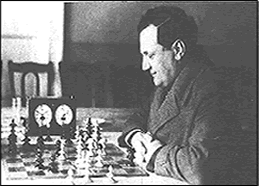 Bora Kostic was born on 24 February 1887 in Vrsac. His first chess steps he
started when he was ten, and as early as he was in grammar school he was one
of the best chess-players in Vrsac. His biggest competitor from the grammar
school days was five years older, Sava Gerdec, who taught him the chess theory.
Their fight for the chess reputation was finished when Kostic went to study
to Budapest. He finished Oriental trade academy there, but without neglecting
chess.
Bora Kostic was born on 24 February 1887 in Vrsac. His first chess steps he
started when he was ten, and as early as he was in grammar school he was one
of the best chess-players in Vrsac. His biggest competitor from the grammar
school days was five years older, Sava Gerdec, who taught him the chess theory.
Their fight for the chess reputation was finished when Kostic went to study
to Budapest. He finished Oriental trade academy there, but without neglecting
chess.