Viktor Arsenovich Goglidze was born on 27 November 1905 in the village of Ursatyevskoye, Tashkent Region (now Khavast, Syrdarya Region of the Republic of Uzbekistan). His father, Arsen Goglidze, had left Georgia for Uzbekistan in search of work. He worked as a cook and later opened his own buffet. From an early age Vitya and his elder brother Sergo had to help in the family business. Viktor received his primary education at a provincial four-year school, but as one of its best pupils he was fortunate enough to transfer to a gymnasium in Tashkent, where, in his final year, he learned how the chess pieces move.
“I was 17 years old when I learned to play chess. The game completely captivated me, and I searched for players in Tashkent against whom I could improve my level. In those years several strong chess players lived in Tashkent, among whom Sergey Freiman stood out. Before coming to Tashkent, Freiman had lived in St Petersburg and often participated in various tournaments; he became a master in 1911. Later Freiman played a major role in the development of chess in Uzbekistan and influenced my style of play” (V. Goglidze).
After graduating from the gymnasium with a gold medal, Viktor entered the Tashkent Conservatory to study conducting. He was passionate about music and played the piano, clarinet and trumpet. He studied at the conservatory until February 1924, but his large family no longer had enough money to support his further education, as they also had to provide for the third son, Vladimir.
Goglidze began working as a bookkeeper, occasionally taking part in chess tournaments. In 1924 he finished third in the Tashkent Championship. The young player was greatly impressed by Tartakower’s book The Hypermodern Chess Game, and after reading it he considerably improved his strength. With his parents’ consent, Viktor left in 1925 for his ancestral homeland of Georgia, where chess life was flourishing at the time.
The visitor from Tashkent began working as an instructor at the Dynamo society and edited the chess column in the newspaper Young Communist. In 1928 Goglidze became the first official champion of Georgia.
Paolo Iashvili, who headed Georgian chess at the time, took steps to give Goglidze a chance to compete for the master title. Iashvili persuaded the USSR Chess Federation to allow Viktor to play a match for the title of master against the well-known Moscow chess player Nikolai Grigoriev (1928).
“The match began on 6 October in the large hall of the Tbilisi Hotel. The beginning of the match was a real disaster for me – Grigoriev took a 4:1 lead. However, I pulled myself together, and before the final game the score had become 4.5:4.5.
Everything was decided in the tenth game. On 16 October all the corridors, shop windows and streets adjoining the hotel were completely blocked by spectators. The game should have ended in a draw, but during the adjourned session Grigoriev was able to take advantage of a mistake and win” (V. Goglidze).
The magazine Shakhmatny Listok wrote that 800 people attended the final game. In total, the match attracted four thousand spectators.
Two years later Goglidze received and successfully used a second opportunity to earn the master title, defeating Vladimir Nenarokov 7:4. Viktor Goglidze’s friend, the writer and playwright Soso Begiashvili, recalled that as soon as the eleventh and decisive game ended in victory for the Georgian player, the entire hall rose and began chanting, “Hurrah! Hurrah!”, after which the spectators lifted Viktor onto their shoulders and carried him all the way home.
In 1931–1934 Viktor Goglidze won a masters’ tournament involving players from Ukraine, Transcaucasia and Uzbekistan, triumphed in an exhibition tournament featuring Hans Kmoch, and twice qualified for the finals of the USSR Championship. These successes opened the door for the Georgian champion to the 1935 Moscow International Tournament, in which practically all the strongest chess players in the world took part. Goglidze performed very creditably: scoring 50% and drawing with Capablanca was a solid achievement.
After returning, Viktor continued his studies at the Polytechnic Institute, wrote extensively about his favourite game, and coached young chess players. By this time his brother Sergo had become People’s Commissar for Internal Affairs of Georgia and a man close to Lavrentiy Beria himself. The brother of the powerful commissar was elected chairman of the Georgian chess section in 1936. In the same year Goglidze’s daughter was born; she later became the world-famous pianist Marina Mdivani.
In 1937 the USSR Championship was held in Tbilisi, and on home soil Goglidze achieved an outstanding result, sharing 5th–7th places with Lisitsyn and Belavenets. Viktor Arsenovich was then included in the 1939 training tournament in Moscow and Leningrad, where among the players who finished near the top of the table he lost only to Samuel Reshevsky. In 1941 Viktor Goglidze was awarded the title of Honoured Master of Sport of the USSR, becoming only the third person in the country to receive it after Romanovsky and Ryumin.
Thanks to his brother’s support, the well-known chess player entered government service and virtually gave up competitive play. In 1946 the head of the Georgian chess movement arranged for Paul Keres to come to Tbilisi to take part in an open tournament. At that time Keres was under investigation, but the intervention of Colonel General Sergo Goglidze, a candidate member of the Party’s Central Committee, allowed the Estonian to break through the circle of restrictions around him. In 1949 Viktor Goglidze served as an arbiter at the USSR Championship and became an arbiter of All-Union category, and a year later he headed the Soviet delegation at the Candidates Tournament in Budapest.
After that, however, a dark period began in the life of the Goglidze family. Following Beria’s arrest, the master’s elder brother was executed. Viktor was removed from his position as head of Georgian chess and was subjected to persecution as a relative of an “enemy of the people”. His portrait was removed from Dynamo’s hall of fame, and newspapers published insulting feuilletons about the master’s chess activities.
After a 15-year break Viktor returned to the chessboard and became one of the heroes of the USSR Team Championship in 1954. His victory over Bastrikov, together with draws against Gipslis, Bannik and Simagin, showed that one of the leading figures of Georgian chess had not lost his practical strength. In 1957 Goglidze, together with Giorgi Merkvilaadze, opened the first specialised chess school in Tbilisi. It still exists today, and some of the strongest Georgian women chess players, as well as Elizbar Ubilava and Zurab Azmaiparashvili, emerged from its ranks.
On 22 September 1964 Viktor Goglidze died suddenly of a heart attack. From 1969 onward, memorial tournaments dedicated to the first Georgian master were held in Georgia, attracting some of the strongest grandmasters from the USSR and abroad. The last such tournament took place in 1988.
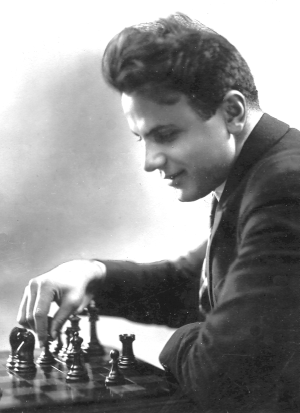 Viktor Arsenovich Goglidze was born on 27 November 1905 in the village of Ursatyevskoye, Tashkent Region (now Khavast, Syrdarya Region of the Republic of Uzbekistan). His father, Arsen Goglidze, had left Georgia for Uzbekistan in search of work. He worked as a cook and later opened his own buffet. From an early age Vitya and his elder brother Sergo had to help in the family business. Viktor received his primary education at a provincial four-year school, but as one of its best pupils he was fortunate enough to transfer to a gymnasium in Tashkent, where, in his final year, he learned how the chess pieces move.